Thailand Scams Tourists Should Watch Out For
Welcome to Bangkok, Thailand. This is the Land of Smiles. Thailand is one of the most visited countries in the world, and Bangkok is consistently the most visited city in the world. And with so many tourists, you’ll also find plenty of scams and hustles.
I hope this post helps you avoid any scams or hustles that you might encounter. I’ll cover transportation scams, sightseeing scams, plain old walking around scams, shopping scams, banking and credit card scams, restaurant scams, tour scams, accommodation scams, nightlife scams, and phone and internet scams.
That’s a lot of scams. But after watching this video, you’ll be able to confidently anticipate all of the scams that you might encounter here in Thailand. And let me know in the comments: have you experienced any scams in Thailand? Did I miss any important scams?
Let’s get started with transportation scams, as these are extremely common and almost impossible to avoid.
Airport Taxi Scam
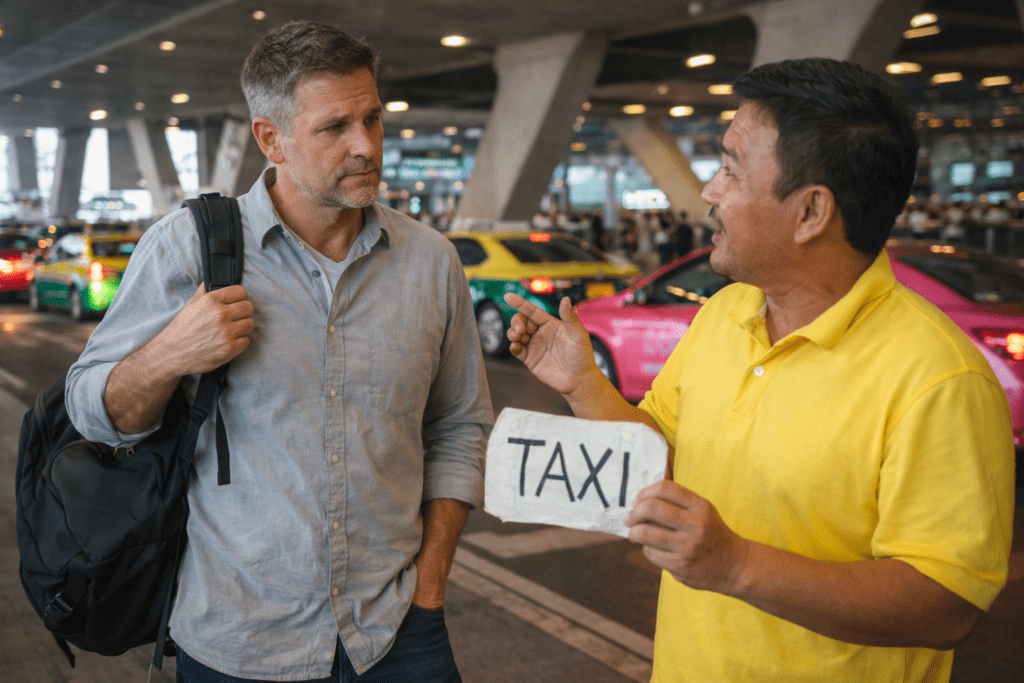
The first scam that you might encounter occurs when you walk out of the main airport at Suvarnabhumi. From the airport, you’ll have two options for taking a taxi into the city. You can walk directly outside at the second level, and here you’ll have plenty of taxis sitting and waiting, and a tout will come and ask you where you’re going.
I recently returned from a trip and I went to check what the price would be to get back to the Rama 9 area here in Bangkok, and the tout quoted me at 1,000 baht to get to Rama 9. I immediately turned around and went down one floor to Level 1. On Level 1, you’ll find the regulated airport taxis. These taxis use a metered rate plus a 50 baht airport surcharge, and the ride back to Rama 9 cost 150 baht plus the 50 baht airport surcharge.
If you plan to take a taxi from the airport, always take a taxi from the regulated airport stand. Just keep in mind that if you’re driving into the city, normally you will have to pay a toll to take the highway. The driver will ask you to pay it, and you’ll be given a receipt. And of course, you can also take the Airport Rail Link into the city.
The “No-Meter” Taxi Scam
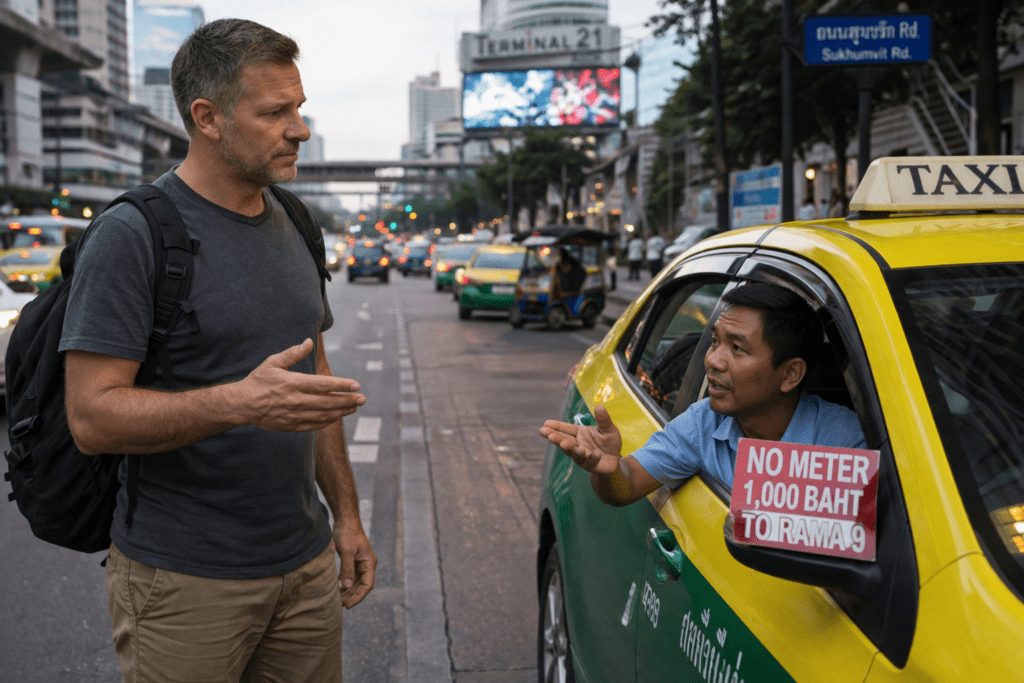
The airport taxi scam that I just described is one example of a very common scam here in Bangkok. This is the “no-meter” taxi scam. In Bangkok, taxis are legally required to use the meter, and the meter is very inexpensive. But this law is often ignored, and you’ll encounter many taxis that refuse to use the meter and demand a set price for a trip and that price is often much higher than the metered rate.
First, you should always avoid taking a taxi that’s waiting by the curb in a popular tourist area. These taxis will almost always demand a set price. You should wave down a taxi that’s driving by on the street, and when you get in, they should turn on the meter. If the driver doesn’t turn on the meter, say “meter krub” this is a polite way of asking them to use the meter. And if they refuse to turn on the meter, simply get out of the taxi and wave down another taxi. It’s quite common to wave down multiple taxis in popular tourist areas before a driver will agree to use the meter.
The Fast Meter Scam
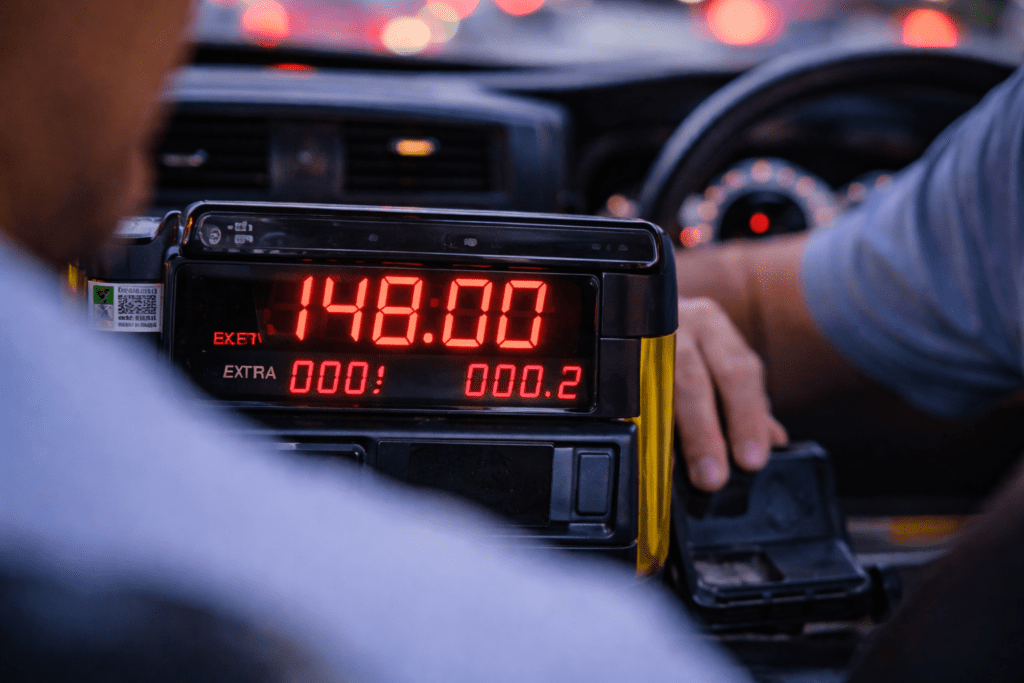
And once you’ve successfully waved down a taxi and they’ve agreed to use the meter, you might encounter our next taxi scam. This one happened to me a few years ago. At the time, I got in the taxi and the driver simply turned on the meter. A journey of 5 kilometers with light traffic will normally cost you about 55 baht, and a 10 kilometer journey will normally cost you about 80 baht. The meter goes up slowly and steadily.
But on this particular journey, the meter started racing at about 5 times the normal rate. This is the fast meter scam a meter that’s rigged to speed up when the driver hits a switch. Just keep an eye on the meter, and if the meter suddenly starts jumping by 2 baht every few seconds, you have a taxi with a fast meter.
But this scam can also occur with a meter that suddenly stops working. When the meter stops working, the driver will use it as an excuse to demand a much higher set fare. If this occurs, it’s best to offer the amount that was on the meter, get out, and get a new taxi.
The Scenic Route Scam
But even if the meter is on and running correctly, you might encounter the scenic route scam. In this situation, the driver takes a much longer route in order to increase the fare. This one can be pretty annoying because it will also add significant time to your journey.
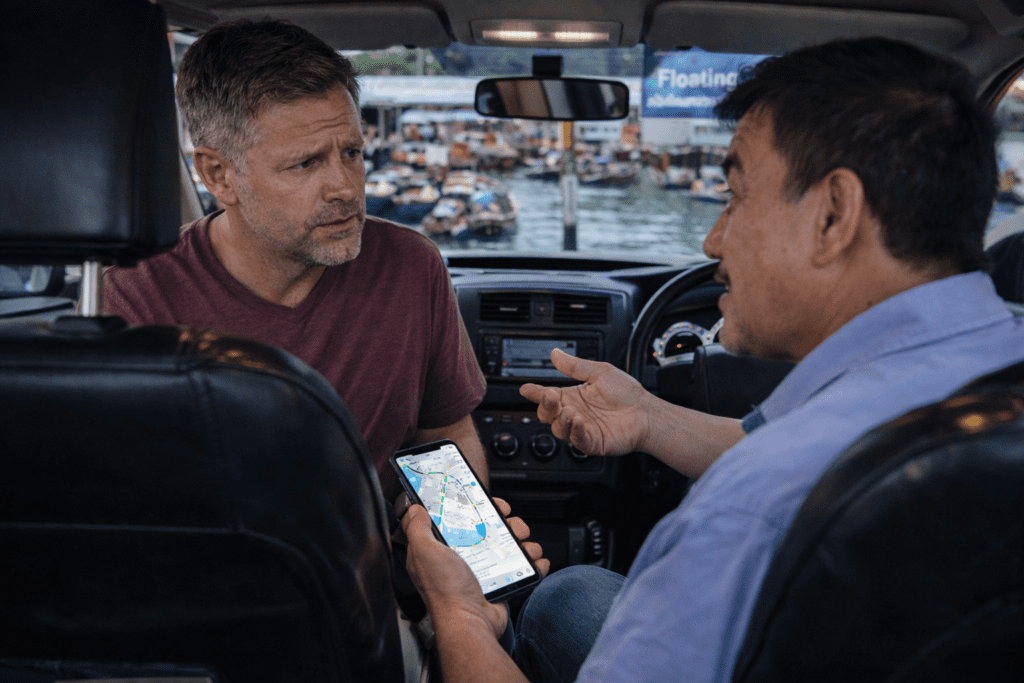
The best way to avoid this scam is to open Google Maps when you get into the taxi and track the route that the driver is taking. When the driver begins to take the wrong direction, normally I will tell them to go the right direction, and if they refuse, I’ll tell them to let me out of the car.
Taxi Driver Commission Scams
During your taxi ride, your driver might also recommend that you check out some different places while you’re in Bangkok. And in this situation, it doesn’t really matter what they recommend you should never go. There are a lot of scams that start this way: overpriced seafood restaurants, overpriced gem shops, overpriced tailors, overpriced tours you get the idea.
Taxi drivers are a little bit like affiliate marketers. They have you in their backseat, and they hit you with a 20-minute sales pitch, and they’ll get a commission for bringing you to any one of these overpriced shops.
But there are also situations where the driver will deliberately bring you to the wrong location. A very common example of this is when you take a taxi to very popular floating markets. Unscrupulous taxi drivers have been known to bring unsuspecting tourists to the wrong pier. And if they bring you to that wrong pier, you’ll be asked to pay 2,000 baht to enter the floating market with a boat ride. You should always keep your Google Maps open and make sure that the driver is taking you to the correct destination.
The Wrong Change Scam
So you managed to wave down a taxi, they turned on the meter which was running normally, and they drove you straight to the correct destination. You notice that you only have a 1,000 baht note, and you ask the driver if he has change for 1,000 baht. He says yes. You hand over the 1,000 baht note, and you can probably guess what happens next.
This is the wrong change scam. Never enter a taxi without carrying smaller bills.
And the wrong change scam can play out in a number of different ways. Some taxi drivers get very creative with this. A friend of mine told me about a taxi ride he had about a year ago. The driver was very friendly and talkative and this can sometimes hint at a potential upcoming scam. The driver eventually asked my friend if he could trade him ten 100 baht notes for a 1,000 baht note. He took out the 100 baht bills, counted out all ten of them, and handed them back to my friend to count as well. My friend counted the bills and everything looked normal, and he said okay. He gave the taxi driver the 1,000 baht note, and about 30 seconds later, the taxi driver held up a 100 baht note and said, “You gave me the wrong bill.” He’d swapped the 1,000 baht note for a 100 baht note and was now trying to get another 1,000 baht. An argument ensued. Ultimately, my friend gave the driver an extra 50 baht to simply end the argument.
There are a couple of lessons that you can take from this encounter. First, you need to ignore any requests that a taxi driver makes. It’s usually a scam or a hustle, and you simply shouldn’t take the risk. This particular scam was a wrong change scam, but it easily could have been a counterfeit money scam. It was a weird request, and any weird request from a taxi driver is almost always a scam or a setup for a scam. And second, if you do find yourself in a scam, the scammer will often accept a deal rather than escalate into an open conflict.
Ride-Hailing App Scams
But even if you get a reasonably priced ride, you still need to be careful with ride-hailing apps. They’ve become very popular, and with popularity you get scams. I experienced a new one a couple of months ago.
If I’m traveling between cities, I often book a car using Bolt for example, to travel between Bangkok and Pattaya, it only costs about 1,200 to 1,400 baht. On a recent trip, I was traveling with a couple of friends and we booked a car to pick us up at Terminal 21 in Pattaya and drop us off in Bangkok. The driver picked us up and drove us to Beach Road in Pattaya. He then asked us to change cars because he had a problem with his car. When we arrived in Bangkok, the driver asked for more money. I took out the app and I showed him the price on the app. Eventually he gave in and he accepted the Bolt price, so we escaped any scam. But there was obviously an attempt to get a little bit of extra money.
My recommendation is to avoid any situation where the car changes this means that you’re no longer taking the car that’s registered on the app.
But you might also encounter drivers that send you messages requesting more money to come pick you up, or once you arrive and get in the car, they will ask for more money. This is much more common in cities like Phuket and Pattaya, but it can occur in Bangkok as well.
In cities like Phuket where there is a very tightly controlled taxi market, there’s likely collusion between the taxi driver cartels and the drivers on the apps. They want to make the apps unusable, and this means that they will randomly cancel at the last minute, they’ll send messages requesting that you cancel, they don’t move for 10 or 20 minutes, and you’ll probably play a game of cat and mouse for a while before you get a legitimate driver.
There’s a second hustle that I encountered about a year ago on Grab. This time I ordered the Grab Taxi this is the metered fare with a 20 baht booking surcharge. When I got in the taxi, the meter was already at 50 baht. He had turned on the meter when he accepted the ride and he was trying to charge me for driving to the location to pick me up. This is not how the Grab Taxi option works. I told this to the driver, and he reset the meter. The Grab driver should only turn on the meter when you get into the car.
Bus and Train Station Scams
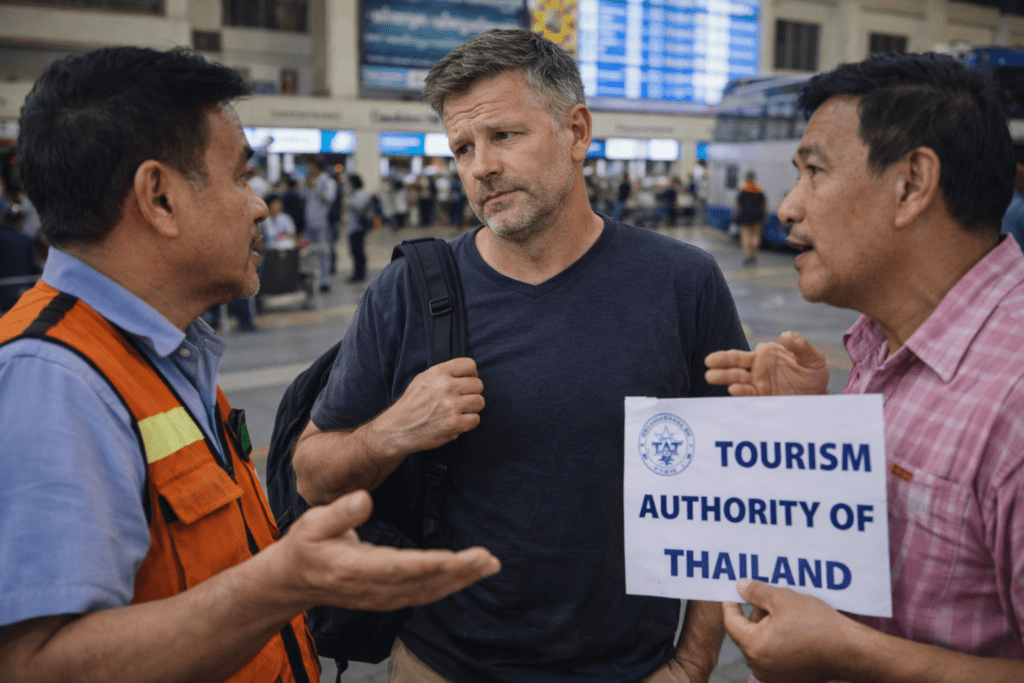
Let’s move on to a scam that you might encounter when you’re traveling between cities by train or bus. When you walk up to a train or bus station, you might encounter a tout that asks you where you’re going. When you tell them, they’ll tell you that there are no more seats on the bus or train, but they’ll offer you transportation with a bus or a van, and sometimes claim to work for the Tourism Authority of Thailand.
These are all lies. It’s very easy to walk up to a train or bus station at nearly any time and buy a ticket on the spot. And the Tourism Authority of Thailand is a government agency they don’t run tours, and they definitely don’t employ touts that hover around train and bus stations asking people to get in their van. This is just an attempt to divert business to private bus and van services. These will normally be overpriced, and you can often wait a very long time if you do happen to take one of these vans, as you’ll need to wait for them to fill the van to capacity before they leave.
Motorbike and Jetski Rental Scams
Perhaps you’re looking for your own transportation and you’d rather rent a motorbike. In this scam, I’m going to cover both motorbikes and jetskis the parameters of the scam are almost exactly the same. In this scam, the rental shop will try to blame you for preexisting damages to a motorbike or a jetski.
I’m going to go over 3 steps that you can take to protect yourself from this scam.
First, you can rent a motorbike or a jetski directly from your hotel. Many hotels have rental agencies, and they’re very unlikely to operate any scams it would be very damaging to their hotel as a brand.
This brings us to the second step you can take: check Google Reviews. Bigger shops that have been in existence for a very long period of time with lots of reviews are very unlikely to operate scams.
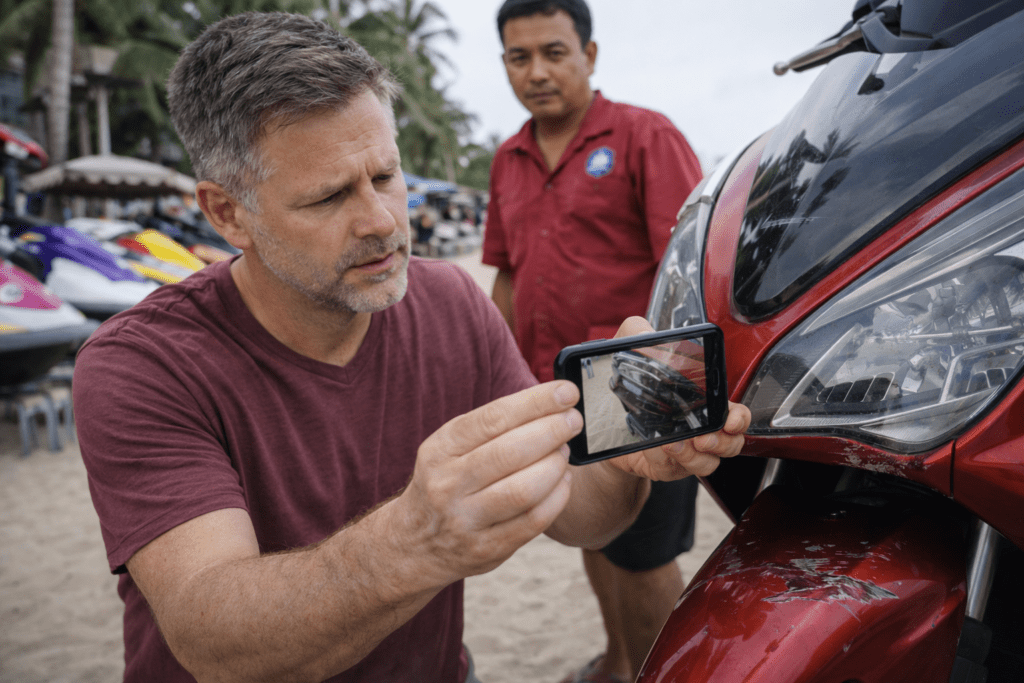
And third, when you rent a bike or a jetski, make sure to take lots of pictures and videos and document any damages that you notice. However, the worst scammers can use temporary paint to cover up damages that they can later wipe off in order to try to blame you. And for that reason, step 1 and 2 can actually be more important.
And for jetskis in particular, you can take one additional step: just hang out at the beach near the shop. You can observe how the shop interacts with customers, especially when they return the jetski. If everything appears to operate smoothly for the other customers, chances are it will be fine for you too.
And finally, if you rent a motorbike or a jetski, never leave your passport as a deposit. If it’s lost, you’ll have a significant problem. And if the shop is running any scams, they can hold your passport hostage to demand a much larger sum of money.
Walking Around Scams
Let’s talk a little bit about the scams that you’ll encounter simply walking around here in Bangkok. These normally occur in very touristy areas like Khao San Road, the old city around the Grand Palace, and between Asok and Nana in Sukhumvit.
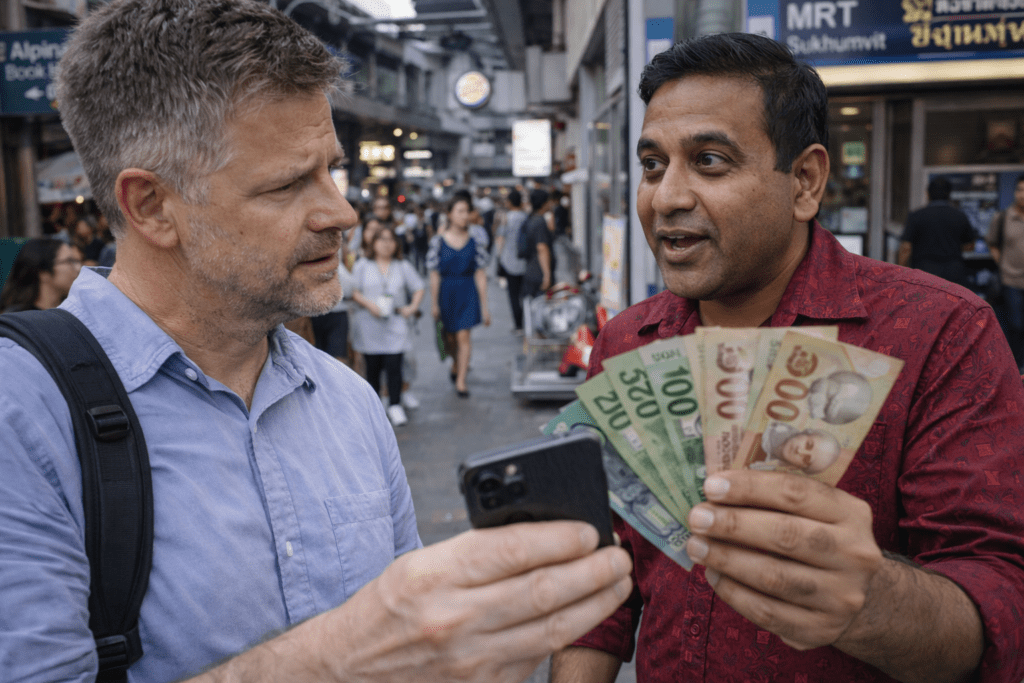
Let’s get started with one that I actually experienced twice just this week. I was walking out of the MRT at MRT Sukhumvit. An Indian guy approached me and he started asking me about the color of Thai money “What color is Thai money?” And then he took out his wallet and opened it. There were a few bills in the wallet, but it wasn’t Thai baht. After showing me his money, he asked me to show him the color of Thai money. I told him that I didn’t have any Thai money. Then he asked me where I’m from. I said that I’m from Canada. He talked about how much he loves Canada and how he plans to visit soon. And you can guess what happened next he asked me to show him Canadian money. Clearly, this guy really wanted to see my money. At this point I had enough, and I simply said no and walked away. He protested; he wanted me to stay.
This is something scammers are very good at. They try to build a connection and build rapport, and they try to make you feel guilty for walking away. When you notice that they’re trying to scam you, they’ll ask you where you’re from, they’ll ask you about your country. These guys study and learn a few things about each country in order to appear authentic, and then they try to create a perception that this was an authentic personal connection during your trip.
Another common scam that you’ll encounter along Sukhumvit is the pseudo fortune-tellers. These guys are normally Indian or Nepalese, and they’ll initiate a conversation with you by saying, “You’re very lucky! Do you want to know why?” But they’re only lucky if they keep on walking. If they stop, these guys will do some half-baked fortune-telling, and then they’ll ask you for money for the privilege of the fortune-telling experience.
Both of these are examples of a very common friendly stranger scam. A friendly stranger approaches you in a tourist area, he tries to build an authentic and genuine connection with you, and then he’ll use that connection to try to scam you. There are many variations to this scam. The number of variations grows every single year as entrepreneurial scammers come up with new methods to try to get money through this friendly stranger approach.
I’ll run through a few of the most popular variations of this scam.
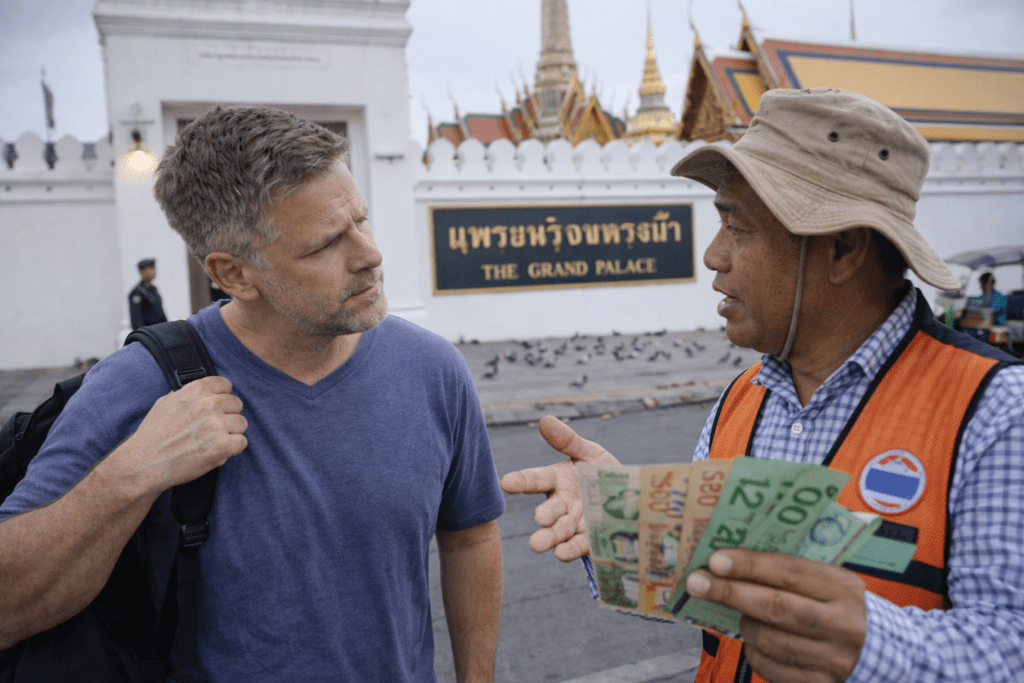
The “Attraction Is Closed” Scam (Grand Palace Scam)
First, we have the popular tourist attraction is closed scam. This is also known as the Grand Palace scam because it occurs very frequently around the Grand Palace, but it can occur around any major tourist attraction. The scammer will approach you before you get to the entrance of the tourist attraction, and he’ll tell you that it’s closed. He might say that it’s a special holiday or that it’s the King’s birthday, and he’ll offer to bring you on his own personal tour. This is a lie. The tourist attraction is almost never closed. If you follow him on his personal tour, you’ll get led into a variety of other scams. Often he’ll bring you to a totally different free attraction where one of his colleagues will be waiting, and they’ll charge you a ticket price to enter.
“Free” Item Scams
Another common scam is when people are standing around in tourist areas and offer you things that seem to be free. The most common variations of this scam are the bird seed scam you’ll have an older man giving birds some birdseed; he’ll offer you some birdseed so that you can join him or you’ll have somebody try to put a bracelet on your wrist. In both these cases, you’ll be asked for money afterwards. You have to remember that nothing is free in very touristy areas.
Tailor and Watch Scams
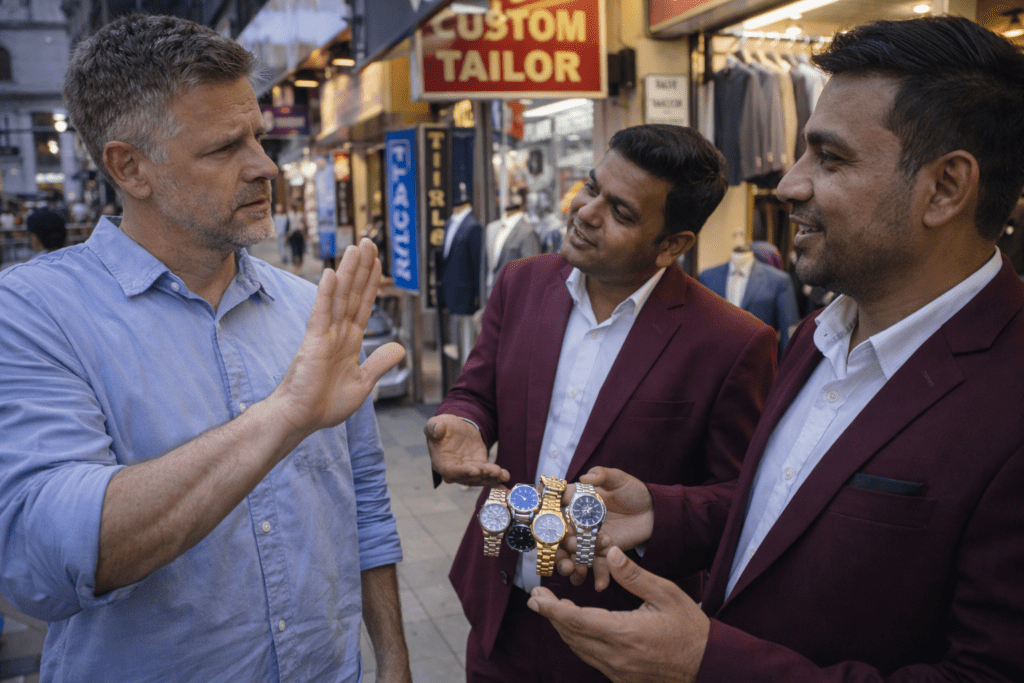
If you walk around any tourist area, you will notice lots of Nepalese and Indian guys trying to sell you suits and watches. The watches are totally fake, and the prices are very high.
The suit guys are a little bit different. There are actually some excellent tailors in Bangkok where you can buy great, high-quality, inexpensive suits. But the touts are much more likely to bring you into an overpriced shop, and some of them will run outright scams. The most common scam is when a suit tailor uses cheaper material to manufacture the suit after you’ve already paid for it. You can avoid this scam by researching tailors using Google Reviews and avoiding places that employ a lot of touts and try to get tourists to come in off the street.
Tout Discount Scams
Another scam that you might encounter is when a tout offers you a discount for a service or product. This is common if you’re walking around checking out places like massage shops. If you’re standing outside and checking the prices, a tout may approach you and offer to bring you to their shop where they’ll give you a discounted price. They’ll walk you to the shop and ask for payment. The tout normally doesn’t work there he just wanders around on the street pretending to work for shops and pocketing the money.
You can follow one simple rule: you should never follow a tout anywhere. Whatever deal they’re offering is normally a hustle or a scam.
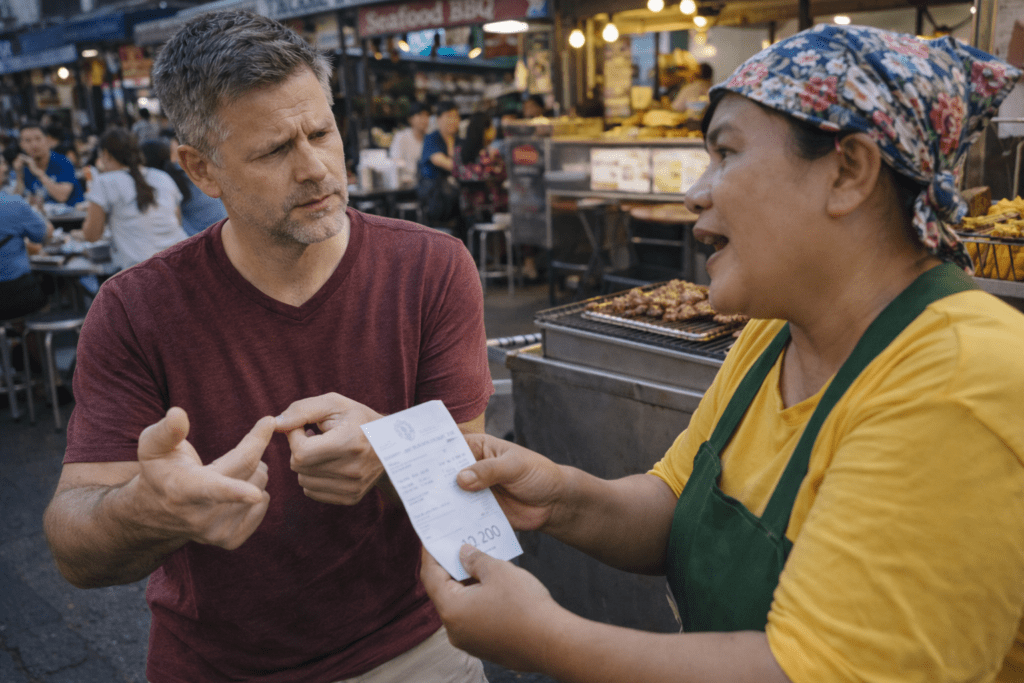
Menu Scams
Most shopkeepers and vendors are good, honest people. But you can occasionally encounter a scam. Always ask for the price or to see a menu before you order, especially in the tourist areas. If you don’t ask for a menu, it’s a little bit similar to getting into a tuktuk without first negotiating the price. You can encounter an unscrupulous vendor who will ask you for a lot of money simply because they know you didn’t see the menu.
Pickpocketing
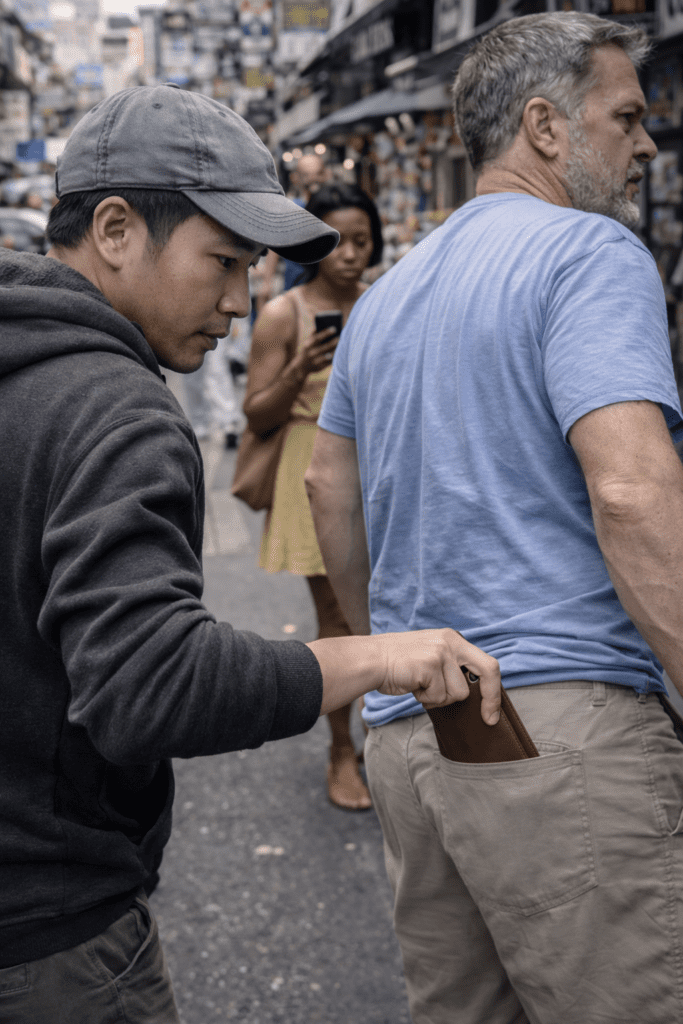
As you walk around in tourist areas, you also need to be careful about pickpocketing. You can take a few steps to protect yourself here. First, never leave your phone sitting on a table in a popular tourist area. It’s also better to wear shorts or pants with deep pockets or even zippers, and make sure to keep your belongings in front of you. Pickpocketing gangs have also been associated with credit card fraud and theft. If you lose your wallet, you should immediately cancel all your credit cards.
Beggar Scams
If you’re in the Sukhumvit neighborhood, you might notice that there are a lot of beggars. Many are women with young children or people with physical deformities. Recently, you had stories about Chinese beggar gangs moving into Bangkok. But you might also encounter the infamous white begpackers of Asia. These guys take advantage of visa-free travel in order to go beg in significantly poorer countries. These guys could easily work as an English teacher and earn higher than the national average income. If you’re going to donate to somebody in need, is a backpacker who is using that money to finance their travels really the most worthy person of that donation?
It’s also very common to encounter other Westerners who will ask you for money for all kinds of different things. These guys might approach you directly, or they might try to befriend you before they ask for money. If they approach you directly, they’ll often say that they need money for a ticket to return home, or that their wallet was lost or stolen. I actually had one guy ask me for money because he didn’t have money to pay for a tattoo. And there is one very famous old German guy who hangs around Terminal 21. He’s approached me a few times over the years to ask me for money to return home. It’s safe to say that he isn’t using that money to get home.
And there was another German guy with a leg deformity. He used to boast online about how much money he made begging in Bangkok, which he used to finance his partying lifestyle in Pattaya. He was eventually banned from Thailand.

Expat Investment Scams
Among the expat population in Thailand, you have plenty of investment scams and hustles. You should avoid trusting people too easily, and if someone pitches you a new investment or asks you for money very soon after meeting, it’s probably better to find some new friends.
Accommodation Scams
Next up, we’ve got accommodation scams. I recall when I first arrived in Bangkok, I booked a hotel on Booking.com, and on the website it looked quite nice clean, spacious, and new. But when I arrived, it looked dirty, small, and old. The reality is that the hotel was using older pictures that they had shot using a wide-angle camera lens.
You’re probably aware that reading reviews is important before booking a hotel. But Thailand has strict defamation laws, and over the years I’ve noticed a big difference between the reviews on hotel booking websites like Agoda and Booking.com and Google. The reviews on Google are consistently more accurate and balanced, and I always check the Google Reviews before I book a hotel.
Many travelers opt to book with Airbnb instead, and I encountered a scam using Airbnb a few months ago. I booked a large condo on the app, and when I arrived, it simply wasn’t available. Instead, the host had left keys for two much smaller units. In the end, I canceled through Airbnb and I needed to book a much more expensive last-minute condo. This is a bait and switch scam. Some hosts advertise multiple units; if one is unavailable, they’ll simply offer you another one.

Tour Scams
If you’re in Thailand, you might be interested in an organized tour, but you need to be a little bit cautious. There are some unscrupulous companies that don’t include all of the costs of a tour. These companies will bring you to the destination it might be an island excursion or a safari. When you arrive, you’ll be told that you need to pay an additional fee to enter the island or safari, or you’ll be stuck waiting around for the van to bring you back to your hotel. When you book a tour, always ask exactly what’s included in the price and check the tour company using Google Reviews.
Some of these tours aren’t exactly scams, but they can be massively overpriced. Some of the cheaper tours might use crowded hostels that feel more like a prison cell, as well as bus or train tickets that would have only cost about 15 to 100 baht per trip. After all, local travel in Thailand is very inexpensive.
Nightlife Scams
And of course, Thailand is very famous for its nightlife, and with that fame, you’ve got plenty of scams that you’re going to need to watch out for.
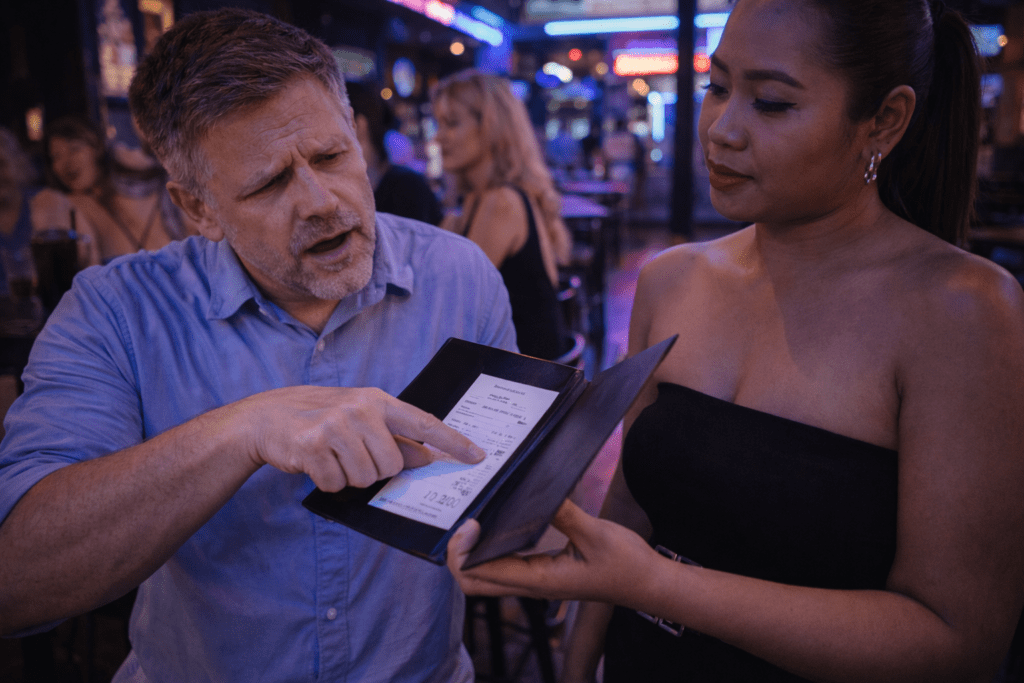
I experienced a common scam quite recently. I was at a restaurant in the Sukhumvit neighborhood. I ordered a dinner, I was out with friends, and when my bill arrived, there was a beer added to my bill. When my friends checked their bills, everybody had a beer added to their bill. I called the waitress over to protest the bills, and as soon as I mentioned the beers, she took the bills and brought back new bills with all of the beers removed.
This is the padded bill scam, and it’s very common in nightlife areas here. And while this scam occurs at restaurants, it happens a lot more in the nightlife areas like Soi Cowboy and Nana. In these bars, the waitress will bring you a bill in a cup, and each time that you order a drink, the waitress will take the bill and bring a new bill with your updated drink total. Normally, if you have a few drinks, the waitress might try to sneak an extra drink onto the bill.
The easiest way to avoid this scam is to simply pay for every drink as it comes. And when you pay for drinks, you also should remember the wrong change scam this is also very common in nightlife areas, and it’s much better to carry small bills with you.
The Pingpong Show Scam
While some bars try to scam you by adding a sneaky extra drink onto your bill, there are other bars that are entirely scams. If you’re not careful and you go into the wrong bar, you could find yourself with an absolutely enormous bill. This is often called the pingpong show scam.
If you walk around the busy tourist nightlife districts, you’ll have many people come up to you saying, “Pingpong show! Pingpong show!” They’ll normally lead you to an upstairs, nondescript area with the promise of seeing a free pingpong show. And as I mentioned earlier, nothing in the tourist areas is free. You’ll be given a drinks menu and asked to order, and when you decide to leave, your bill will arrive and it can be absolutely huge. There are stories of 5,000 baht bills, 20,000 baht bills. At this point, large security guards will block the exit, and you’ll be told to pay the bill.
Never follow a tout, and never follow the recommendations from tuktuk and taxi drivers, especially when it comes to nightlife. And if you do want to check out a go-go bar, I highly recommend that you check those Google Reviews first. The reality is that you have plenty of great nightlife options in Bangkok.
Fake Alcohol
But you might encounter another common scam, and this is fake alcohol. If you’ve ever seen the popular buckets at Khao San Road, these are very inexpensive, they taste horrible, and you’ll often get a brutal hangover afterwards. These areas are somewhat notorious for having fake alcohol, which is normally brought in from Malaysia.
Phone and Internet Scams
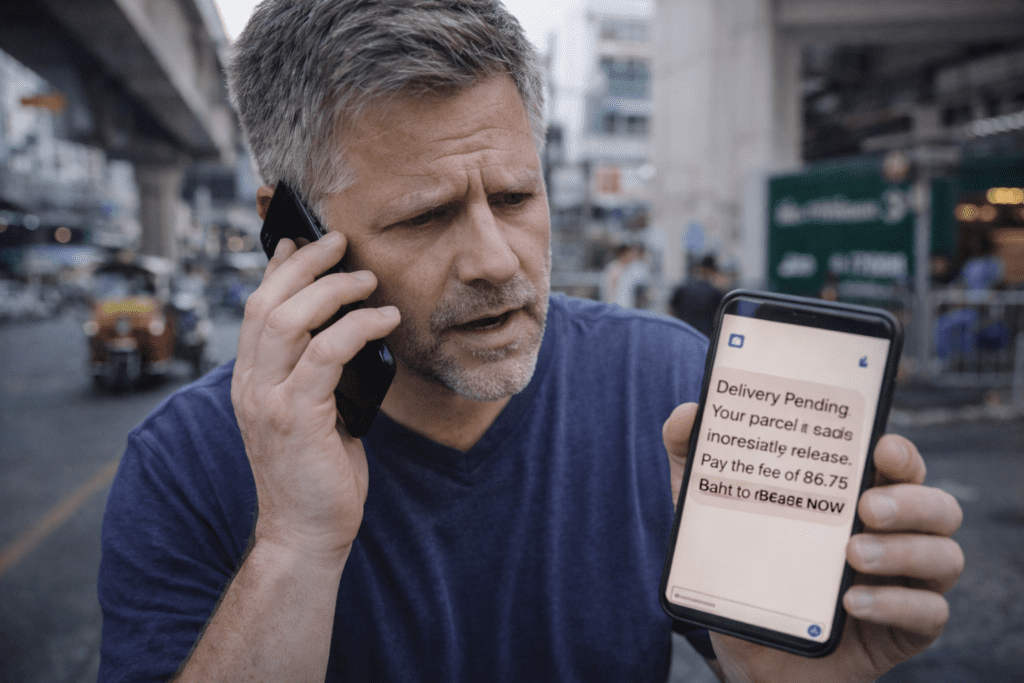
And lastly, when you’re in Thailand, you’re going to want a phone, a data package, a SIM card. And when you register your SIM card, you may get a phone call or a text message telling you that you have a delivery and you need to pay a fee to release the delivery, or that there is an investigation into some type of fraud. All of these are likely scams. There are a lot of text message and phone scams here in Thailand. If you receive a text message or a phone call, don’t make any payments and don’t provide any personal information. You should automatically assume that it’s a scam.
Do not scan an unfamiliar QR code for someone else.
I’m going to cover 31 new scams that you might encounter here in Thailand in 2026. Some of these are global scams that you’ll find around the world that have been on the rise, and others are highly localized. I’ll cover them all so that you can stay safe during your time in this beautiful country.
In-Flight Theft
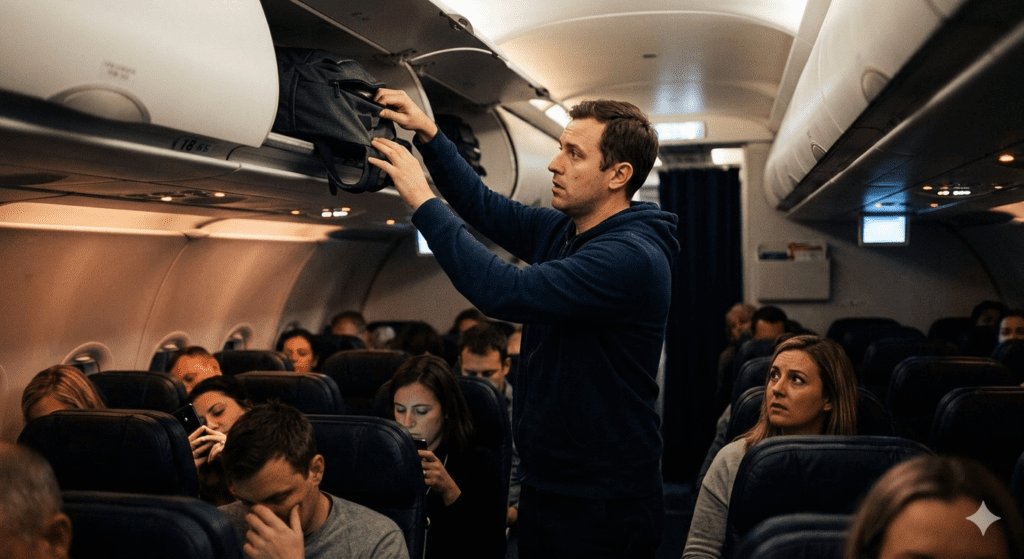
Our first couple of scams might occur before you even step foot here in Thailand. If you’re planning to fly into Bangkok, Chiang Mai, or even Phuket, you should be careful with your carry-on luggage, as there’s been a sharp rise in theft from overhead luggage compartments and even the seat areas. The scam is run by organized groups which normally target certain routes. Thieves work together and wait until the cabin crew dims the lights after meal service. They systematically move around the plane checking overhead luggage or any seat areas for valuables like cash and jewelry. In order to avoid getting robbed, it’s best to keep your valuables with you at all times, and especially when the cabin lights are dimmed.
Fake Thailand Digital Arrival Card Websites
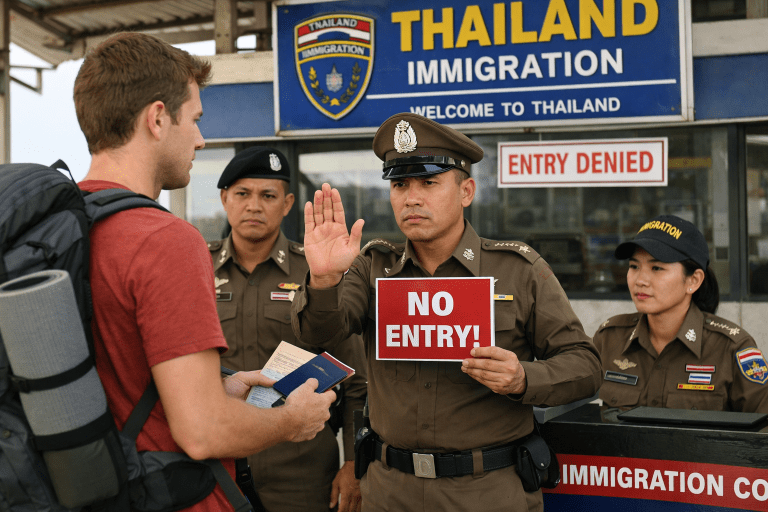
In order to enter Thailand, you’ll need to fill out a digital arrival card. This has caused lots of confusion for many visitors who are planning a trip to the country. Thailand’s digital arrival card is a common target for misleading websites. But as with any new requirement which causes confusion, it can lead to scams. When you’re filling out the card, you need to be aware of fake websites that are masquerading as the official site. Immigration authorities here in Thailand have put out warnings to avoid these sites. They’ll collect your personal information and even ask for payment in order to get the card. The arrival card is free to submit, and you should only use the official website. {prefix}posts
Baht Bus Scam In Pattaya
I covered transportation scams extensively in part one of this series, and many of those scams occur right here in the lower Sukhumvit neighborhood. Normally those include taxis, tuk-tuks, and even motorbikes. But in part two, we’re covering the Songthaew scam. This scam has been on the rise in smaller cities like Pattaya. A Baht Bus is a pickup truck that’s converted into a passenger vehicle with benches in the back. These iconic vehicles drive fixed routes and pick up passengers along the way. They’re normally very inexpensive, costing only a small fee that can be as low as 10 baht per person in Pattaya.
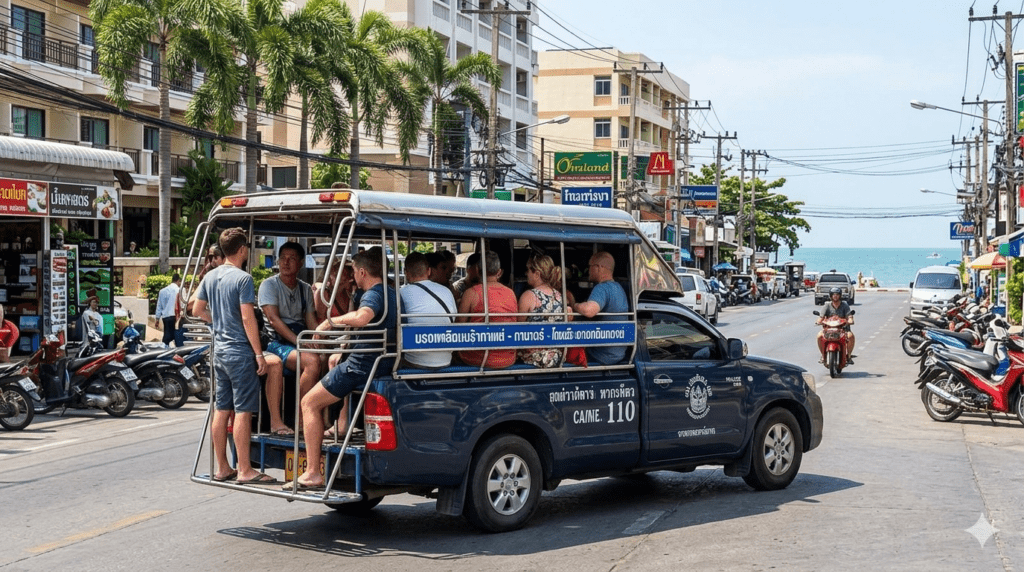
Using a Baht Bus is very easy. Simply wave it down and hop in the back. When you near your destination, ring the bell, hop off, and pay the fare to the driver at his window. But some tourists are unaware of how Baht Buses operate. Instead of hopping in, they approach the driver’s window to ask about the fare or if the driver goes to a specific destination. If you do this, some drivers will drop you off at that destination and claim that you hired the Songthaew as a private taxi with a much higher fixed fare of 200, 300, or even 500 baht, even if your stop was already on the driver’s route or very nearby. It’s very easy to avoid this scam. Follow the Baht Bus protocol. Simply hop on, keep your Google Maps open to track your destination, and ring the buzzer near your stop.
Motorbike Rental Scams
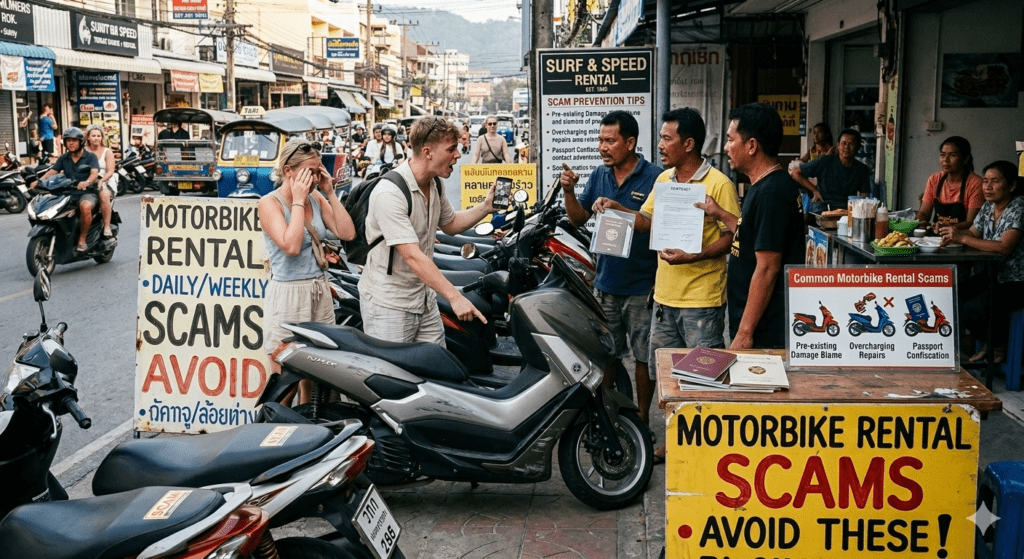
When you visit Thailand, you may be tempted to rent a motorbike. The most common motorbike rental scam is when the shop claims that you damaged the bike and demands exorbitant payment for the repairs. I covered this scam extensively in part one of this series, but scammers are innovative, and there are two additional motorbike rental scams that have been on the rise.
First, we’ve got the fake motorbike theft. This occurs when you rent a motorbike from a shop, but staff from the shop follow you back to your hotel or accommodations and steal it using an extra key. The shop will then charge you for the cost of the missing bike, which can cost tens of thousands of baht.
Second, we’ve got the fake accident scam. You rent a motorbike and take it out for a ride, but later you’ll get a call or a message from the rental shop or even a police station talking about an accident. They’ll inform you that you need to report to a nearby police station. Once you arrive, you’ll be told that a driver has filed a complaint against you for hitting or scraping their car and that you need to pay for the damages. You may not recall any incident, and it likely never happened. This is a scam. The rental shop or an employee is normally in on it. They provide your information to the accomplice who files the complaint.
In order to avoid the fake theft, fake accident, or even the fake damages scam from part one of this series, you should only rent from large and legitimate rental shops. These companies have profitable businesses renting scooters, and negative incidents are harmful for their long-term business.
Fake Fashion Goods
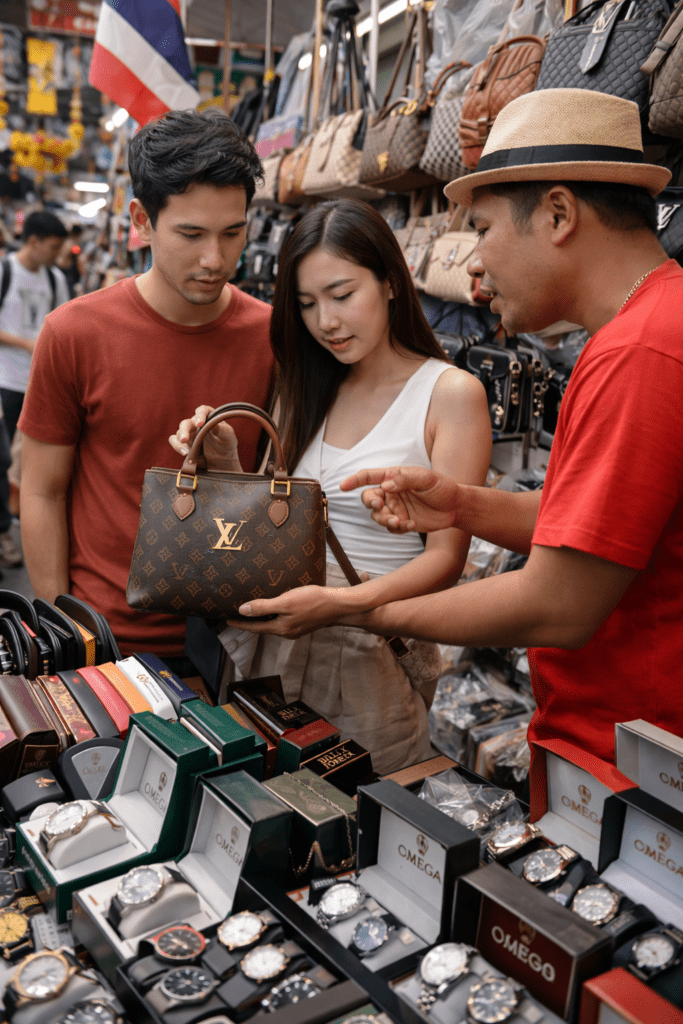
Thailand has a thriving industry for fake fashion products. This is a pretty open secret, and these are normally sold fairly inexpensively by shops and vendors in places like MBK Mall or Pratunam Market. Normally you’ll get a reasonable price, but always be cautious when buying fashion products, as they may be fake or grossly overpriced, especially in tourist-oriented markets and areas. Before you buy, it’s best to take a walk around a market and compare the different prices on offer. And of course, when it comes to fake goods, you can always negotiate.
Fake Electronics and Repair Scams In Bangkok
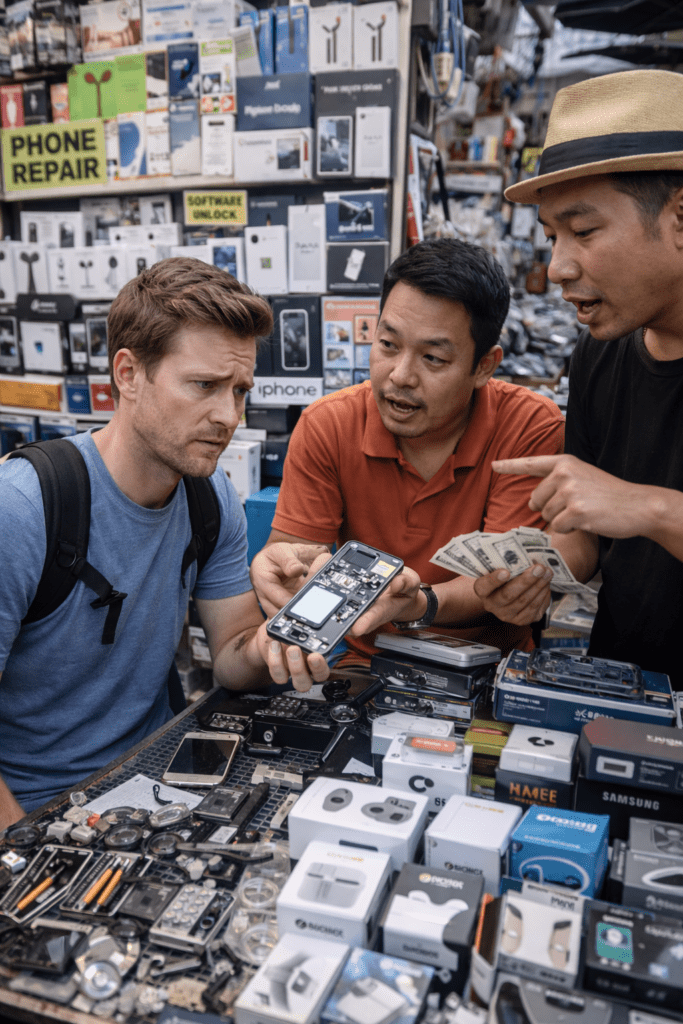
But you can also find fake electronics, and they’re much harder to detect. Some vendors buy used phones or laptops and swap out the expensive components for cheaper inputs. They then sell the refurbished products to unsuspecting customers, normally as authentic used goods. This scam can occur at smaller stalls and vendors throughout the city. If you’re looking to buy electronics, it’s normally best to shop at larger brand name stores, as prices tend to be similar for higher-end brand name products.
You also need to be cautious with electronics repair shops, as some shops may swap out the expensive components in your device for cheaper alternatives and sell the more expensive parts on the resale market. If you’re in need of repairs, only use large shops and check the Google reviews first.
Buying Fake Art In Thailand
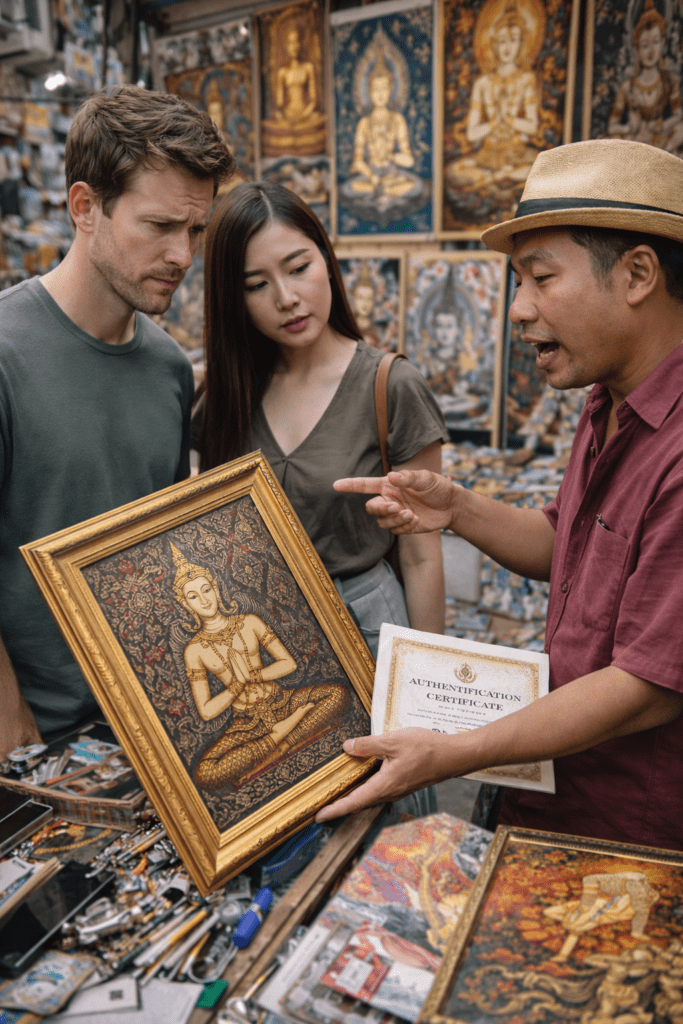
Finally, we have art. If you’re in the market for some authentic art, you’ll find some great pieces here in Thailand. But you should also be cautious. Some sellers may pretend to be the artist or a reputable dealer with authentic art, but often the art is mass-produced in factories in China and sold to the vendors at very cheap prices. It may look great, but it doesn’t carry value as a collectible item. Do plenty of research before buying anything that’s marketed as authentic art.
Overpriced Attraction and Tour Tickets
But it’s not only fashion, electronics, and art that can be overpriced. If you’re planning to visit a tourist attraction, you’ll notice plenty of taxi and tuk-tuk drivers sitting around outside their vehicles with big signs showing the attractions, or you may hop in a taxi and immediately be offered special tour tickets. These are normally overpriced. Drivers serve as middlemen that take a hefty cut, and travelers will get a much better price by paying for the attraction or tour directly.
But there’s a second reason to avoid these tours. You should always read the reviews for any tour before you book it, as many tours offer a subpar experience or end much earlier than scheduled. Personally, I recommend using Klook or Viator. These are apps which list a large number of different tours with thousands of reviews. This allows you to compare each package. If you’re interested in checking out the tours on either site, you can click the links in the description.
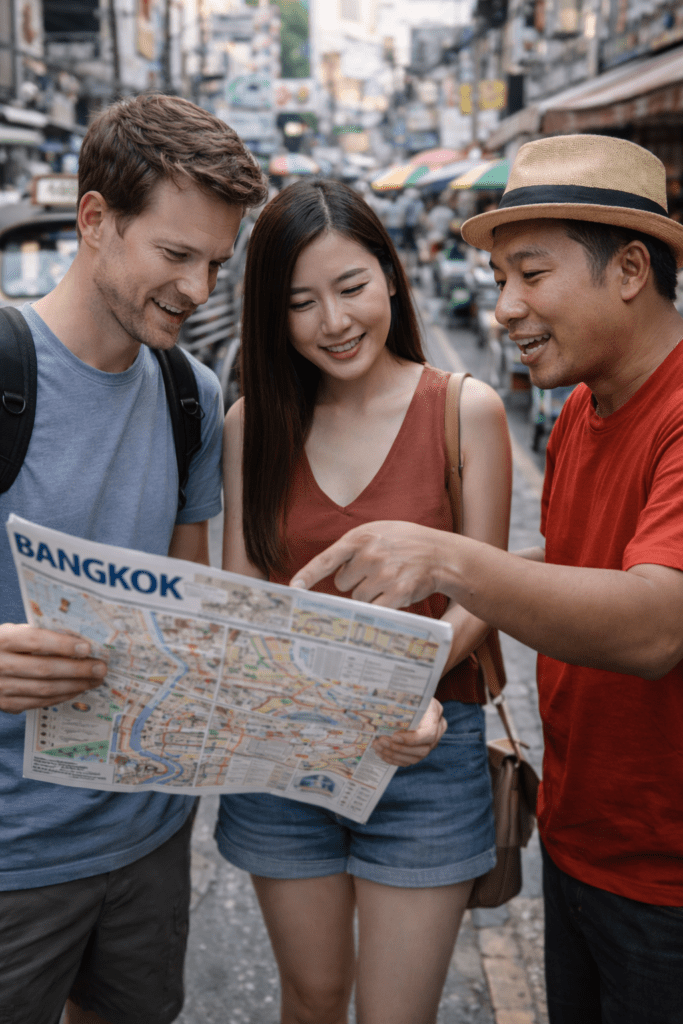
Private Van Tour Reseller Scam
If you take a private minivan or bus, you may encounter yet another tour hustle. The driver will stop halfway through the trip. Passengers will be led into a room with English-speaking staff where they’re asked to provide the name of their hotel for drop-off, but this is all a ruse. It’s actually a room full of tour resellers. Their real goal is to sell overpriced tours. If you encounter this situation, simply give the name of your hotel and return to the van.
Counterfeit Currency at Exchange Booths
You’ll need to be able to access cash during your stay in Thailand. I have a detailed guide on the best ways to access money and all the fees involved. But when it comes to exchanging money, you may encounter people that hang around money exchange booths, especially in lower Sukhumvit around Asok and Nana. They’ll claim that they need to exchange money before they leave the country or that they don’t have a passport with them to use the exchange booths, and they’ll offer you a great exchange rate. It’s a scam, and the currency is counterfeit.
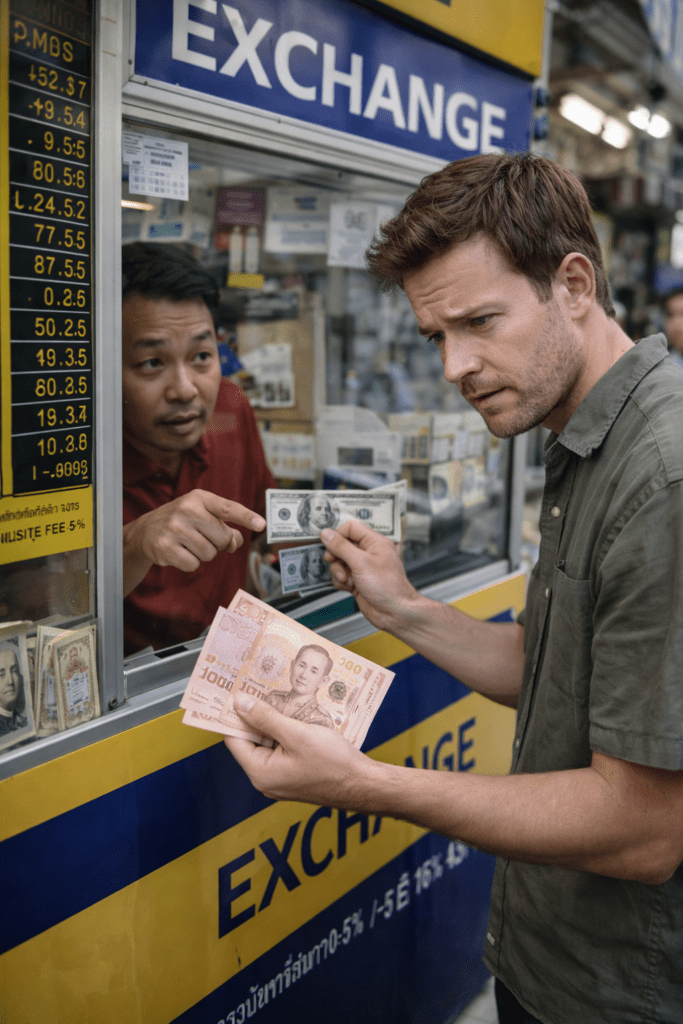
Miracle Cure and Show Me Your Money Scams
The lower Sukhumvit area is a tourist hot spot. I discuss a wide range of tourist hotspot scams in part one of this series, but let’s cover a few more that have become extremely prevalent. First, you may be approached by a a stranger on the street here or in a shop like 7-Eleven. He’ll point out a physical characteristic. Perhaps you’re balding or have acne. He’ll recommend a miracle inexpensive cure and try to bring you along to a shop. It’s all a scam.
Another common variation of this scam involves the man asking to see money from your home country. This sounds pretty crazy, but it’s become so common that it must work sometimes. If you show him, the scammer will use a sleight of hand trick to try to steal some of the money. If that fails, he’ll attempt to trade for his worthless counterfeit currency. as a general rule, but never take out your wallet or show money to a stranger on the street in a foreign country.
Friendly Stranger Scam In Thailand Nightlife
These are both variations of a very common friendly stranger scam that’s constantly adapting here. A friendly stranger approaches you in the street. He may be Thai or foreign. He’ll attempt to build rapport and use that rapport to scam you. There are a wide number of different variations of this scam, but they’re very easy to avoid. If somebody approaches you in a tourist area, just ignore them and keep walking.
Stolen iPhone Follow-Up Scam
When you’re in tourist hotspots, you also need to be careful about pickpocketing and theft. Thieves especially target smartphones, and iPhones in particular, as these have a very high resale value. If your iPhone does get stolen, you may be tempted to turn on Find My iPhone online. But if you do, you’ll receive texts that appear to come from Apple or Google. The text will include a link and instructions to access your iCloud. This is normally the thieves, and the links are phishing sites. If you enter your credentials, the thieves will be able to unlock the phone and sell it.
The thieves may also send you texts directly asking for money with a promise that they’ll send you the phone back. This is also a scam. The thieves will string you along, get as much money as possible, and then disappear with your phone and the money.
Dating App and Investment Scams
Call center scammers are also very active online, especially with dating applications like Tinder, Bumble, and Thai Friendly. The scammers work in teams using sophisticated scripts in order to build a connection with the victims. They build rapport with the target and then introduce investment or business opportunities, or request money to help with medical bills or emergencies. Trust-based scams are extremely common online, but they also occur offline.

Friendly Expat Scam
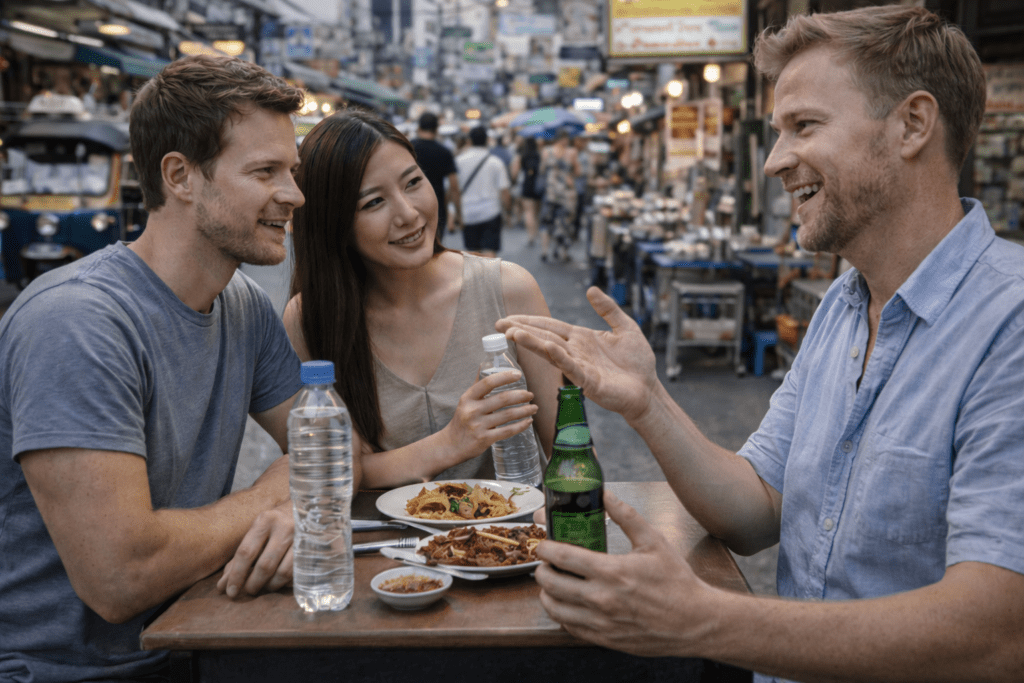
For travelers, one of the most common trust-based scams that you’ll encounter is the friendly expat or seasoned traveler. These are longer-term expats who quickly befriend newcomers, often with great intensity. They attempt to build trust as quickly as possible, which is then used to scam the newcomer. They may attempt to borrow money, push business or investment schemes, or simply steal valuable items. The freewheeling world of Thailand is something of a magnet for con artists from around the world. Don’t trust anybody too easily, especially if you encounter them in a Meetup group, as these groups are a favorite target for con artists looking for newcomers.
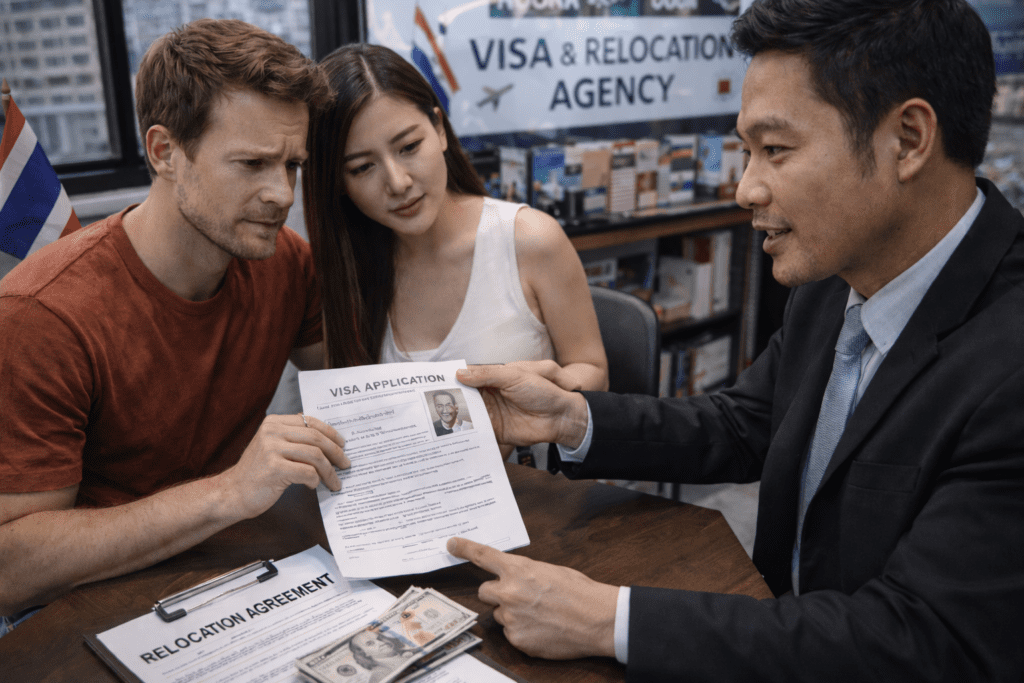
Fake Visa and Relocation Agency Scams
If you’re interested in spending a $3 or even living here, you may encounter our next group of scams. Prospective expats are often in need of relocation advice and assistance, particularly with visas, driver’s licenses, and bank account opening. There are plenty of legitimate agencies, but once you express an interest in agency services, Google and Facebook may start to show you agency advertisements, and many are scams. They may provide fake or fraudulent documents, including fake visas, which are illegal. Do plenty of research before you choose an agency, and check Google reviews and Reddit forums for any specific agency before you sign up.
Fake Condo Rental Scam
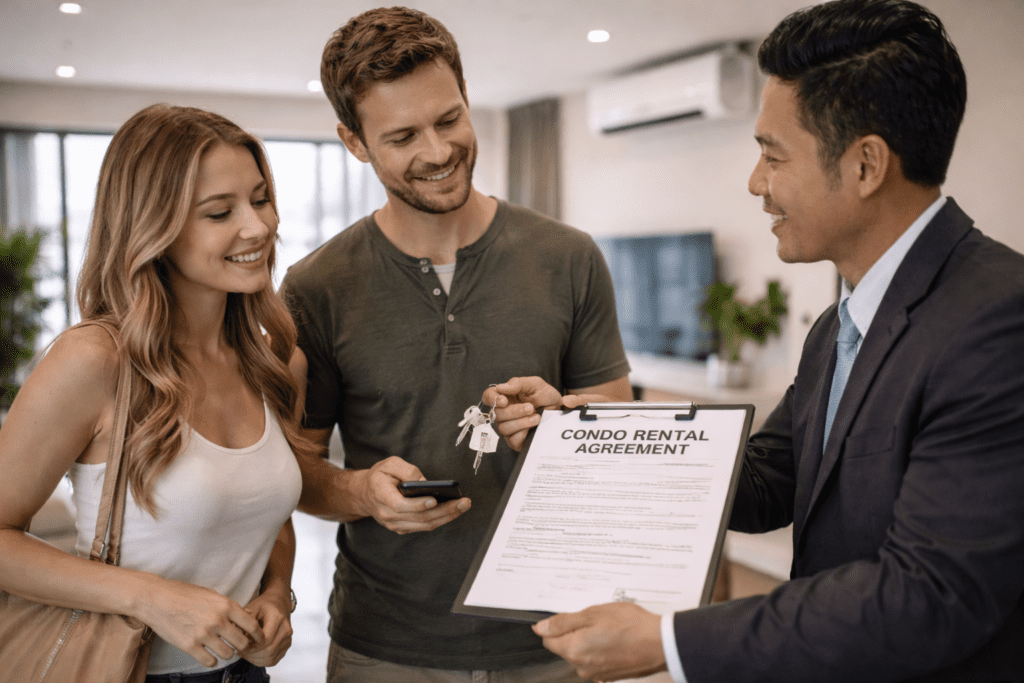
If you’re planning to stay for longer in a city like Bangkok, Chiang Mai, or Phuket, you may be tempted to rent a condo on a short-term basis. You’ll find plenty of listings on Facebook Marketplace and on condo rental sites. But you need to be cautious, especially if you’re looking while you’re still outside Thailand. You’ll encounter listings that offer great value, but the landlord or agent will request that you transfer money in order to secure the lease. This may include a deposit, first month’s rent, or even payment for the entire rental period. Once that payment is received, the post will disappear along with your money. Alternatively, you may arrive and receive keys to a very different and inferior condo that doesn’t match the pictures. Never book a condo or transfer any money while you’re still outside Thailand. It’s very easy to find accommodations after you arrive, and it’s a lot safer.