
Thailand Teaching Survival Guide 2026
Why Teach in Thailand?
There are really two main reasons people decide to come teach here.
The first one is lifestyle. The cost of living is low and you’re surrounded by good food, beaches, islands, and a culture that is generally calm and friendly. Teaching provides a practical means to stay in the country on a longer-term basis with a valid long-term visa and income without years of specialized training.
You’ll get assistance with setting up a bank account, figure out the visa rules and regulations, and generally learn the ropes from colleagues. Regardless of your ambitions, if you want to live in Thailand, teaching has always been one of the best ways to start out here, and it still is.
But there’s a second reason to teach in Thailand, and that is to pursue a proper career in international education. Of course, the beaches, food, and culture are perks, but teaching in Thailand can also be guided by career opportunities.
While these two paths may sound similar, the difference between them is enormous. And which one you take largely depends on your qualifications and long-term planning.

TEFL Style Teaching Jobs
At the most basic level, you have the TEFL style teaching jobs.
The required qualifications and experience are minimal:
- A bachelor’s degree in any subject from an accredited university
- A clean criminal background check
- A passport from a country where English is the native language
A TEFL certificate may help you get hired, but it’s not normally required.
Salaries are typically low, starting at around 35,000 to 50,000 baht per month. It’s not a lot, especially in a city like Bangkok.
The work culture can be difficult with busy schedules and minimal support. Class sizes can be large and classroom management can be tricky. This is full immersion in the Thai system and it’s definitely different.
Vacation time normally ranges between 6 and 8 weeks paid, but some schools will require teachers to run summer school camps, effectively eliminating holidays. Burnout can be common and staff turnover high.
But for all the challenges, these jobs are very easy to obtain and can be a great way to get your foot in the door and establish yourself in Thailand. And there are well-run schools with balanced workloads. We’ll get into how to assess a prospective job shortly.

International Schools
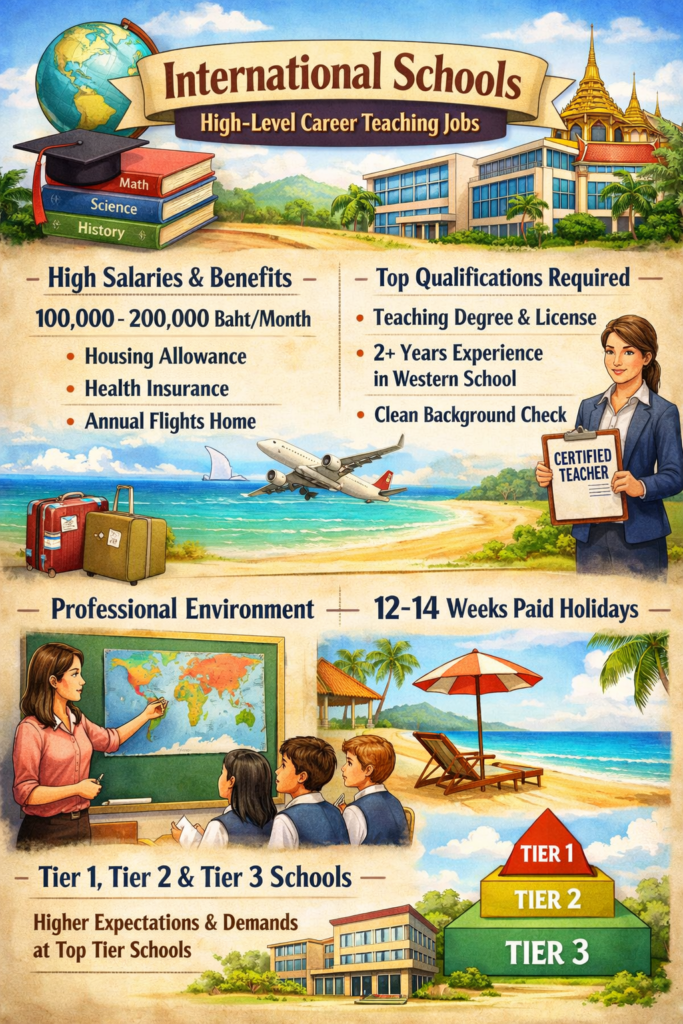
On the other end of the spectrum, you have international schools, and these are effectively career teaching positions.
Salaries and benefits typically match western pay scales, ranging between 100,000 and 200,000 baht per month with housing subsidies, health insurance, return flights home once per year, and 12 to 14 weeks paid holidays.
But you’ll normally need a proper teaching degree and license from a western country alongside all the other requirements. Many top tier schools also require a minimum of two years post-certification teaching experience in a western curriculum school.
These are jobs for career teachers. So the bar is considerably higher.
Schedules are typically well structured with courses in standard subjects like history, math or science. The international system has tiers with higher pay and demands at tier 1 schools and greater variation in tier 2 and 3.
Private Bilingual Schools
Let’s shift to the middle ground.
If you’re not fully licensed, private schools with bilingual programs tend to be your best option. Much like public schools, you’ll only need a bachelor’s degree in any subject and a passport from a native English-speaking country, but a TEFL qualification can help.
Salaries normally range between 50,000 and 70,000 baht per month with 8 weeks of paid holidays.
Office environments range from chaotic to well organized. You’ll normally teach subjects like history, math, or science in English to local Thai students.
If you lack qualifications, this should be what you aim for.

University ESL Lecturer Positions
Next, there are university ESL lecturer positions, and this is where I actually started my teaching career.
Pay is typically lower at around 35,000 baht per month, but there is a lot more autonomy and the schedules are typically very relaxed. It normally felt more like a part-time job.
Qualifications vary. A bachelor’s degree is required and a master’s in any subject helps with the hiring process, but there isn’t a clear requirement.
Holidays are minimal, but most lecturers would schedule their own breaks.

Corporate & Language Schools
Finally, corporate and language schools are often paid by the hour at around 500 baht or 50,000 baht per month for full-time schedules.
On paper, the pay can be okay, but paid holidays are minimal and schedules can be busy with irregular hours.
How to Get a Teaching Job
So, let’s talk a bit about how to actually get these jobs.
For public and private schools or corporate jobs, the website ajarn.com has the most listings. The school year starts in May and the main hiring season kicks off around February.
Applicants should be on the ground in Thailand and available for an interview. You may be asked to do a teaching demonstration.
But there is one important warning: avoid agencies. They typically list jobs that are easily attainable with a direct application at the school and take up to 35% of your salary every month for doing little beyond forwarding your resume.

International School Applications
The international school application process is very different.
Some second and third tier schools will post listings on ajarn.com, but most use dedicated international school sites including Tes, Schrole and International Search Associates.
Applicants normally apply from their home country and the interview process is rigorous with reference and police checks.
The academic year starts in either August or September, and most hiring starts in November of the prior year, but you’ll find some positions open up later if people back out.
Never show up looking for an interview at a school. Security will normally escort you out as these are very secure premises.

New Teacher Traps & Red Flags
But before you start your hunt, there are some things that you really need to know about and avoid.
These are the new teacher traps.
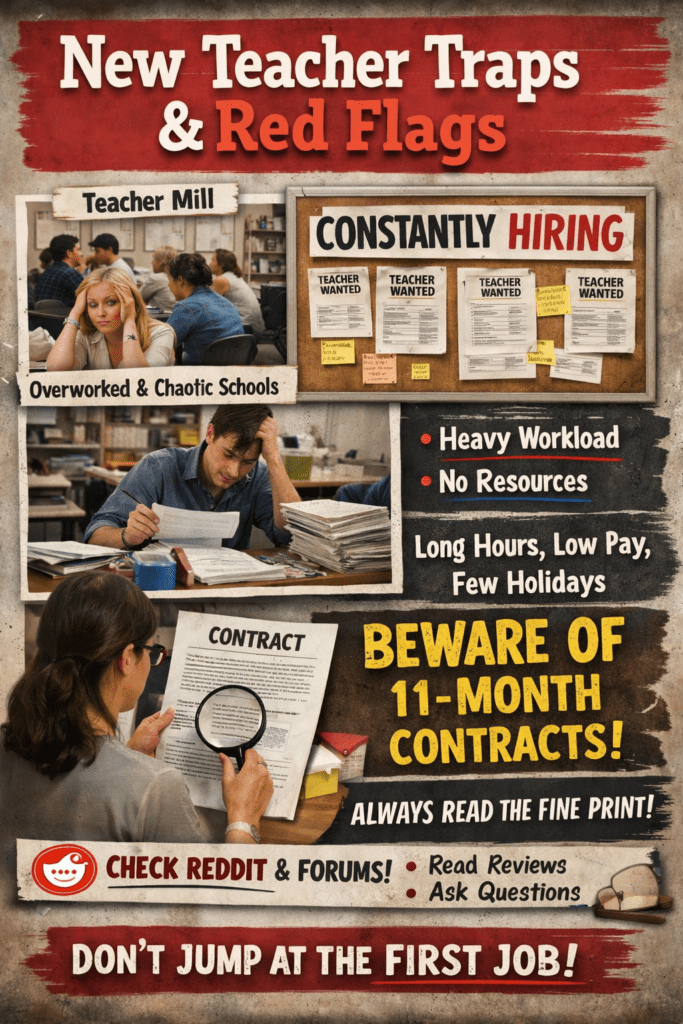
First, the teacher mills. These are schools that are simply poorly managed. They are privately owned and the goal is to maximize profits. Staff rooms are chaotic, teachers overworked, and it’s often a toxic work environment.
But these schools are easy to spot. If you see the same school constantly advertising, it’s because it keeps losing teachers. There’s a reason.
So keep an eye on the listings for a few months before you start applying. Once you go for interviews, don’t jump at the first job.
Ask about your schedule, how many classes you’ll be expected to teach, along with the number of grade levels and subjects. Check what resources and textbooks are available.
You’ll find some schools overload teachers with schedules up to 26 hours across multiple subjects, often with no proper textbooks or resources.
Make sure to ask about holidays: how many weeks? Are there any English camp requirements? If yes, are they paid extra?
Also, check that the contract is for a full 12 months, as you’ll find 11-month contracts designed to avoid paying the last month’s holiday wage.
Once you agree on a position, make sure to check the contract to ensure that it matches your initial agreement. If anything changes, walk away. The school is showing that it is already trying to play games, and those games will only get worse once you’re working.
One of the best tools is Reddit. Look up the school on teacher pages, on Reddit forums, and you’ll get a lot of very useful insights. Read comments, ask questions, and try to talk to prior teachers.
But also remember that some teachers may have grievances, so don’t take everything at face value.
Documents & Legalization
Let’s talk about documents because once you’re hired, the real headache begins.
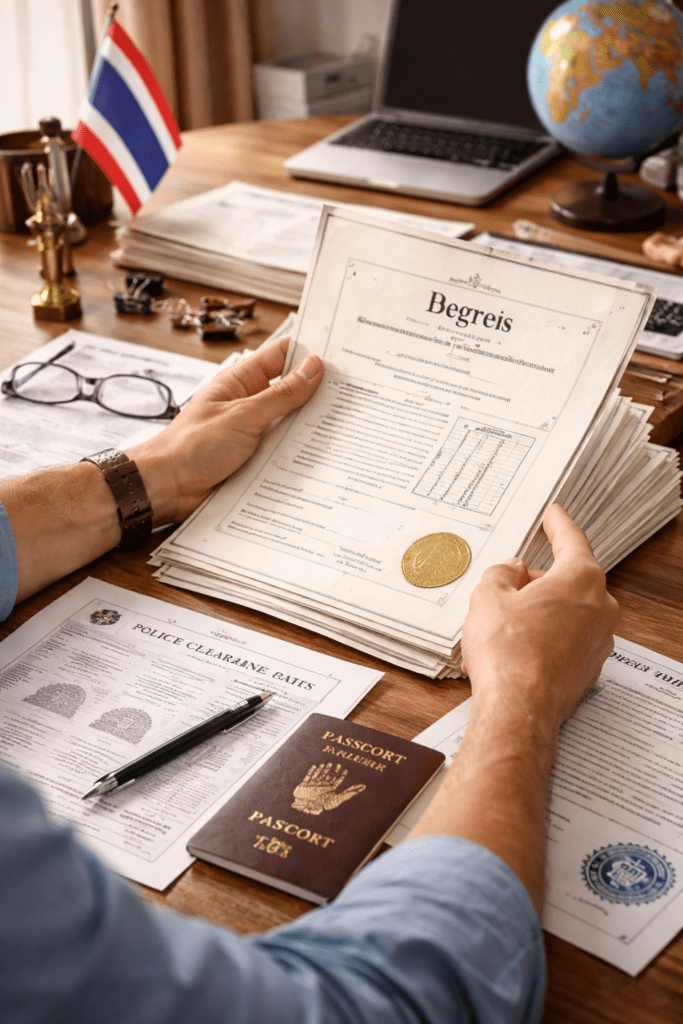
You’ll need your original degree, transcripts, and a police background check. But you’ll also need your degrees and transcripts legalized. This can be a hassle.
To legalize a degree in Thailand, you’ll first need to have your original degree authenticated. Document authentication typically has to be completed by the appropriate authority in your home country and then legalized by the Thai Ministry of Foreign Affairs before it can be used in Thailand.
In most cases, it’s easier to do the authentication while you’re still in your home country, as completing the same process once you’re abroad can involve extra steps, costs, or delays.
The school will then assist with the visa, work permit, and bank account setup. If you’re at a well-run school, the HR will normally handle everything, and the school should always pay for the visa. You just show up, smile, and nod.
Visas, Work Permits & Immigration
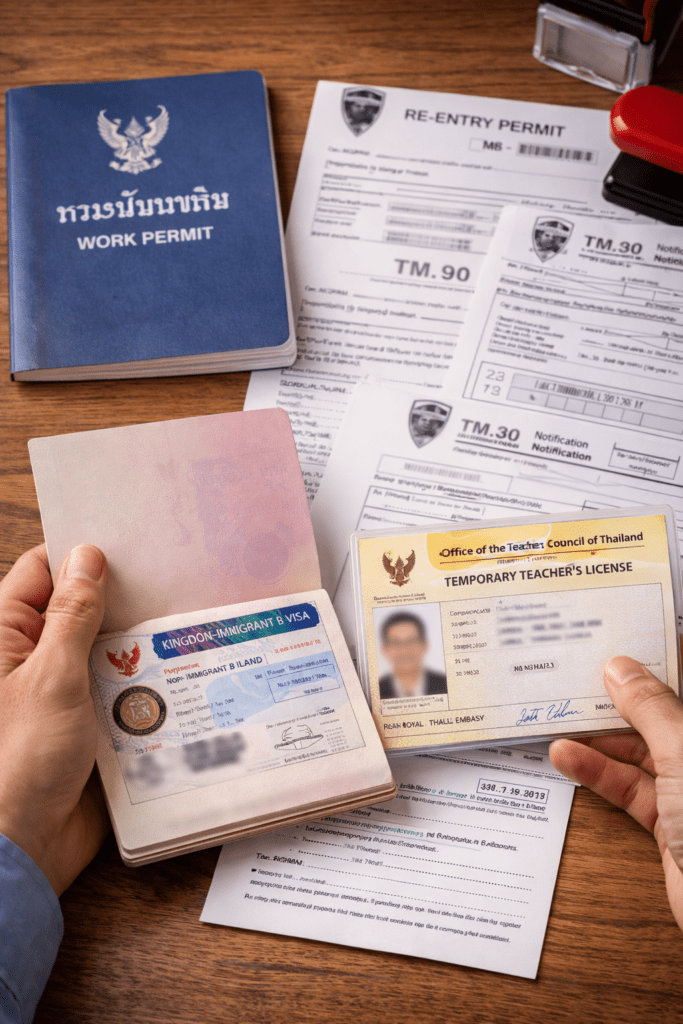
Once you jump through all the hurdles, you’ll be issued a Non-B resident visa, work permit, and a temporary Thai teaching license.
The temporary Thai teaching license operates as a waiver if you don’t have a license from your home country. You’re permitted three waivers for a total of 6 years. At the end of that time, you’ll need to attend courses to get a Thai teaching license.
Once you’re living here, you’ll need to familiarize yourself with the immigration bureaucracy. The TM90 and TM30 require you to report your address. You’ll need to get a re-entry permit if you leave the country. If you don’t, you’ll lose your visa. The school should generally handle all your immigration requirements.
Long-Term Reality & Career Advice
So, should you teach in Thailand?
If you’re already a licensed teacher in your home country, teaching in Thailand offers fantastic career opportunities and great salaries, all in a beautiful and lower cost environment.
But even if you’re not properly licensed, it can be the best way to get yourself set up here in Thailand.
However, there’s an important caveat: don’t stay in lower paid positions in public or private schools for too long without building an escape. It’s a slow career suicide. Your salary may progress, but it rarely keeps up with inflation and job security is typically very low.
I’ve seen it many times. Schools simply push older teachers out once their salary progresses and replace them with fresh young faces. This leaves unqualified teachers in very precarious positions as they age.
Overall salaries have remained stagnant for years. Those 35,000 baht salaries haven’t budged in decades. Even as the cost of living has soared in cities like Bangkok.
If you plan to teach long-term, you need to make plans on how to get into the international school system. The sooner you get the license, the better. Your pay skyrockets along with your opportunities, and it’s ideal to do this at the youngest age possible.
But Thailand is also an excellent place to network and find new opportunities. Many of the most successful digital nomads here actually started out teaching.
And that’s our guide to teaching in Thailand.