Bangkok Street Food Tour Review and Hidden Local Eats
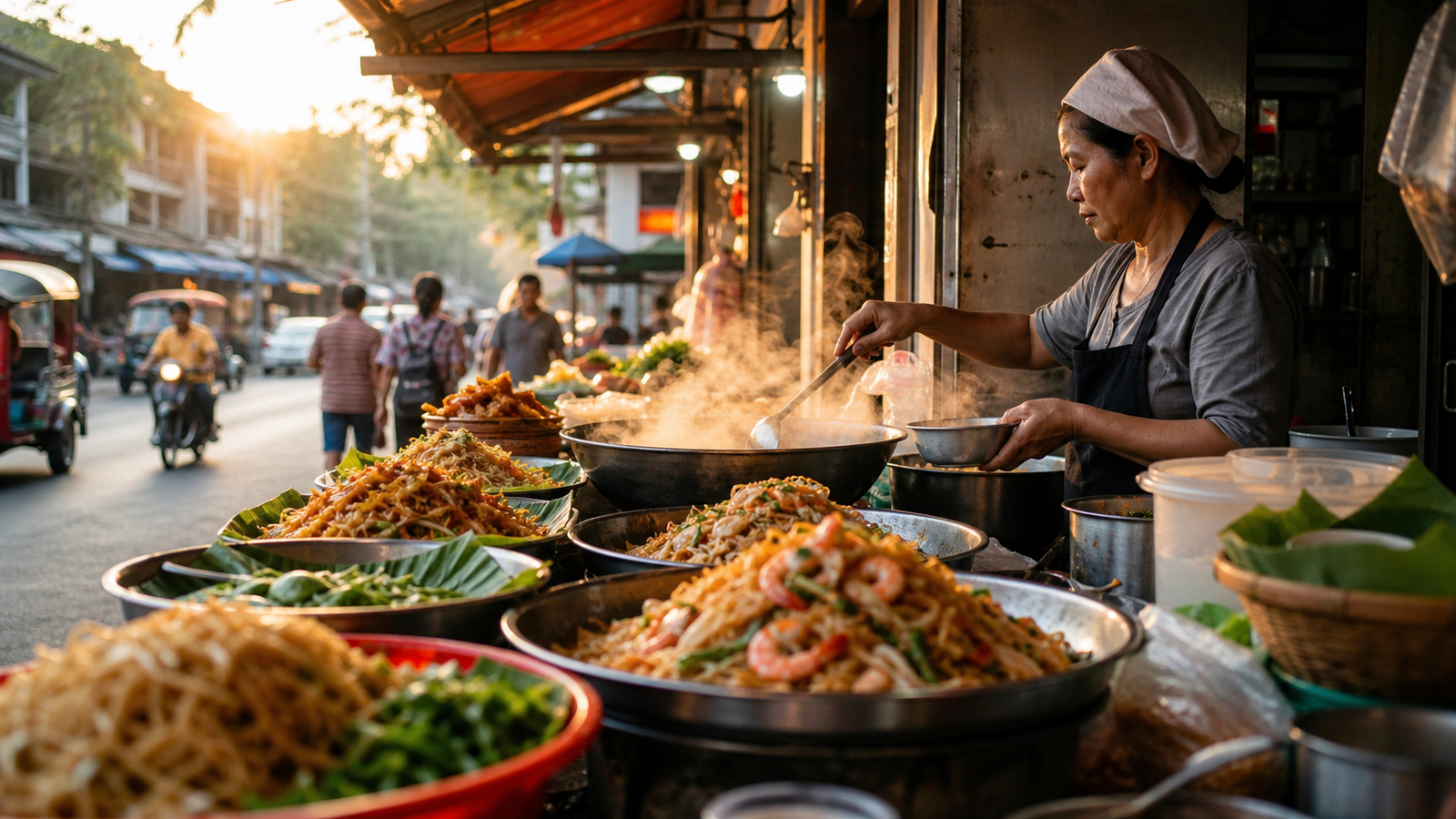
Bangkok has some of the best street food in the world, but most visitors have no idea where to find it. And if you’ve only got a short time in the city, but want to eat like a local, avoid the tourist traps, and explore parts of Bangkok most travelers miss, there’s really only one way to fit it all in.
I recently joined Bangkok’s top rated food experience with a chef’s tour. And honestly, it’s something I think everyone visiting the city should do. The tour took us through hidden, award winning food stands, quiet temples, back streets, and markets far off the tourist trail.
To start the tour, we had to make our way over to the Chit Lom area. This was an interesting starting point because I knew the tour focused mainly on the old town area, while the meeting point was way over in the downtown metropolitan area of Sukhumvit. I knew we were going to cover a lot of ground today. We met the guide and started the tour, heading to a canal boat to check out some of the different markets in the old town. But before that, we got a snack.
Street Food Canals and a Local Market
Despite being in the heart of downtown Bangkok, surrounded by fancy malls and upscale restaurants, we pulled into a local Thai restaurant with a classic Bangkok feel to it with plastic chairs, metal tables, and of course, no air conditioning. Our guide said that this place was quite popular with food vloggers and its signature dish was tom yum dumpling soup. Tom yum is one of Thailand’s most iconic dishes. It’s a hot and sour soup usually made with lemongrass, kaffir lime, galangal, chili, and lime juice. The twist here was that the dish came with deep fried wonton dumplings, and it was absolutely delicious.
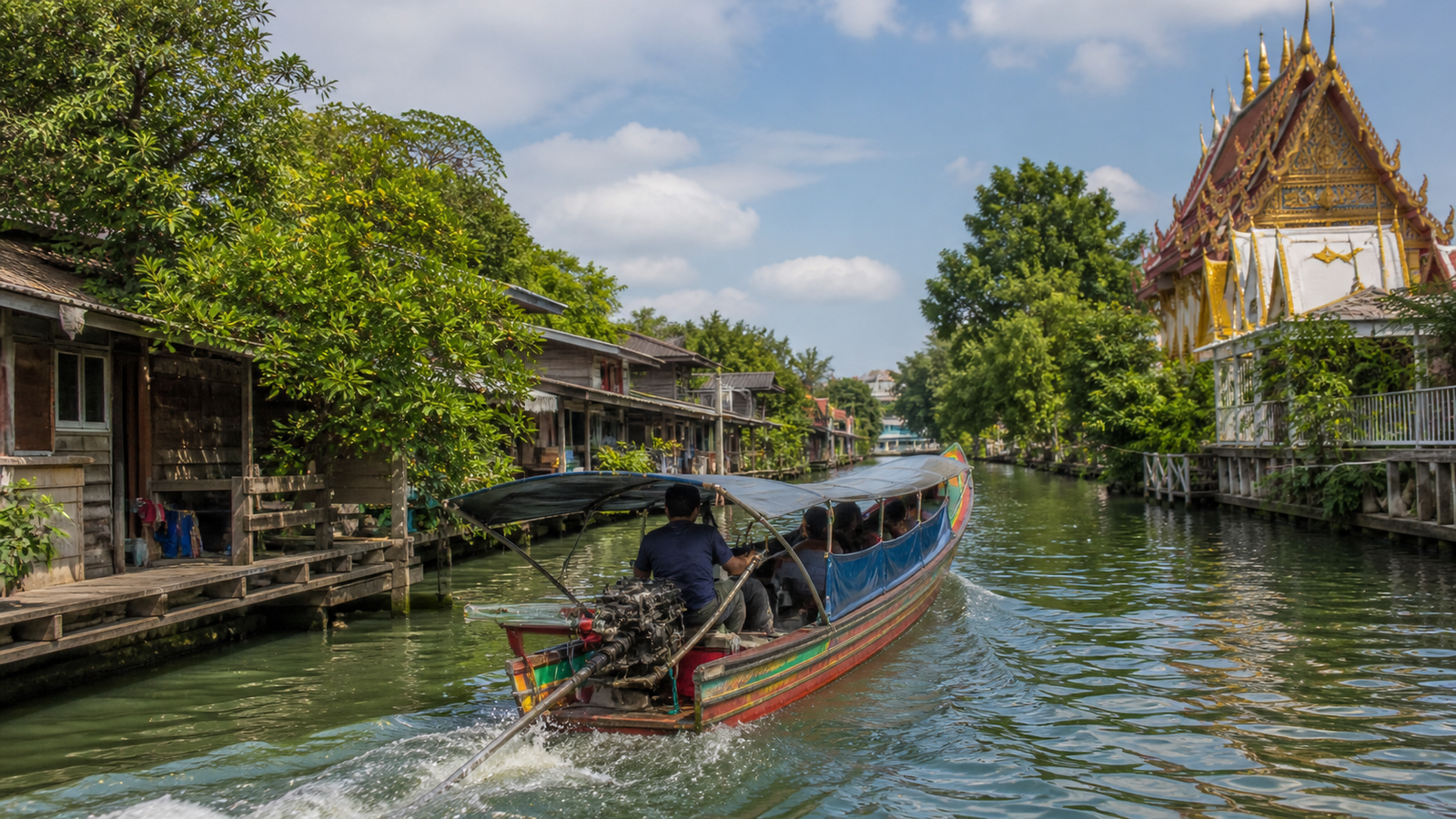
This place was right by the side of the canal, and next we hopped onto a longtail boat for a trip through parts of the city that most tourists never see. One of the coolest parts of this food tour wasn’t actually the food, it was how we got around. We didn’t just walk from stop to stop. We explored the city like a local using public transport most tourists never even figure out how to use.
Bangkok’s canals, known as khlongs, crisscross the city like watery alleyways. In fact, Bangkok was once named the Venice of the East because of this vast canal network. Cruising through the khlongs by longtail boat gave me a glimpse of the real Bangkok as we zipped past houses and temples by the side of the canal. This is also one of the most efficient ways of traveling around Bangkok because there’s no traffic here. We zipped across the city in about 15 minutes and pulled up at a cool local market by the side of the canal.
We stopped by the side of the canal at a cool little local market and a small street food vendor. She said he had been working here for about 30 years. We were going to try something called kiao, which is sticky rice with a bit of taro inside, grilled in a banana leaf. I’d never visited or even heard of this market before. And I think it’s way off the tourist trail because we were the only foreigners here. This could be a really cool place to grab some Bangkok souvenirs. We didn’t actually try the food there. In the end, it took a long time to cook.
Tuk Tuk Ride to Thonburi Breakfast Market
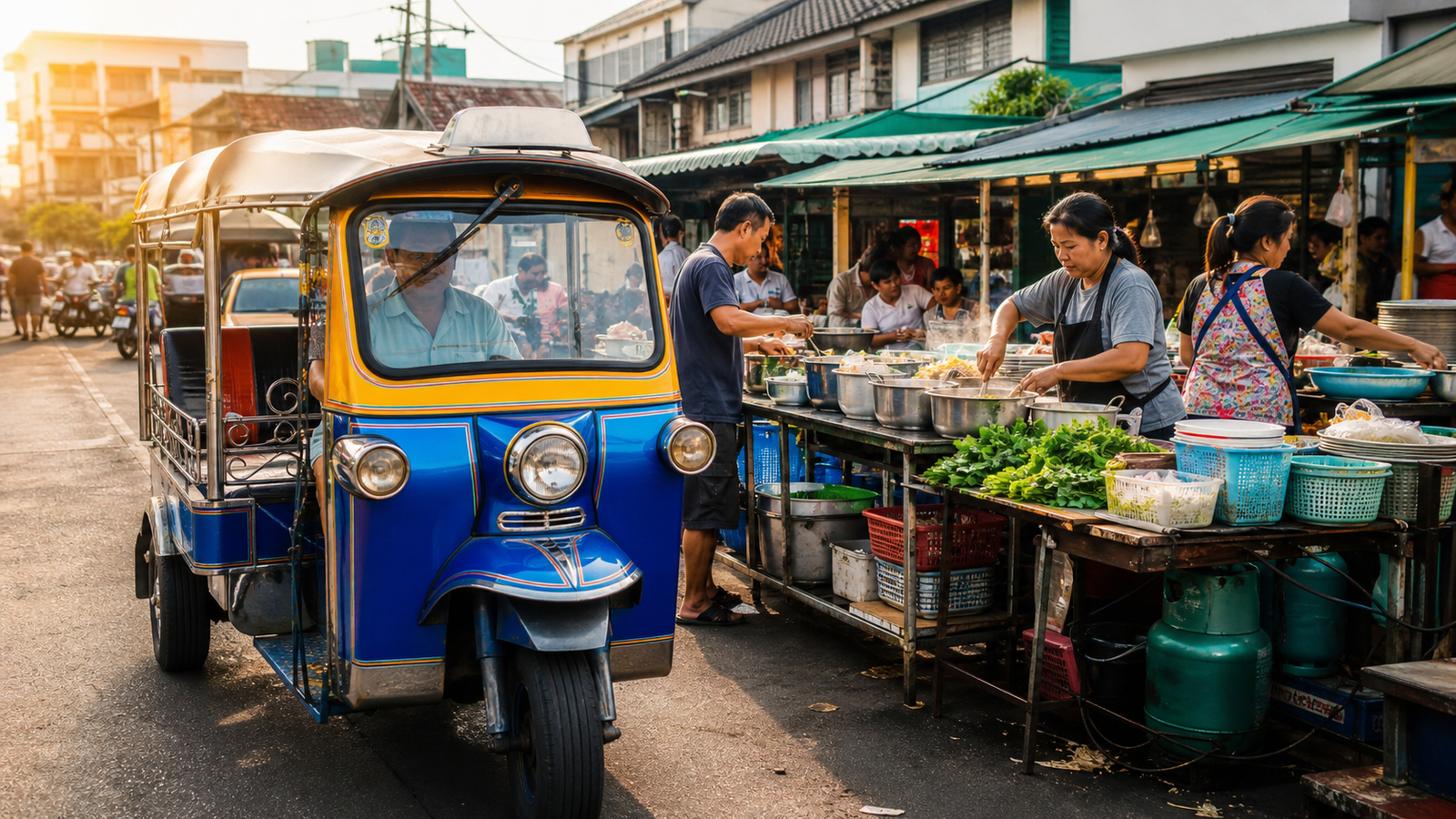
We hopped into a tuk tuk and headed to a different part of town and a street food market. Tuk tuks are one of the most iconic images of Bangkok, but I actually rarely ride in them because they are notorious for overcharging tourists and taking you on detours. On this tour, though, we didn’t have to haggle. The drivers were already there waiting for us, so everything was taken care of.
Racing through the traffic in a tuk tuk was a lot of fun, and we got to see a lot of the city by doing this. We made it all the way from the metropolitan Sukhumvit area to the old quarters of Thonburi. Over here, the buildings are low rise, the pace is slower, and it’s home to some family run restaurants that have been around for generations.
We crossed the city in a tuk tuk. We’re now in definitely a more local area, and we’re about to visit a market. This market is mostly for breakfast, and it looks like there’s still a lot going on here around midday. What I loved about this area was that the restaurants prepared their dishes out in the open, so you could really see what the food was like and be enticed in by the smell. Another benefit of traveling with a guide here was that they could serve as a translator with the local chefs and street food vendors who told us a bit about their dishes.
You can see behind me here, he’s making our breakfast. He’s making hoi tod, which is like a crab or mussel omelette. And that’s what we’re going to be trying next. After seeing all these dishes, I was definitely ready to eat again. We sat down to eat the khao ping and our freshly made crab omelette. I’ve got the khao ping that we were cooking before. It’s in a banana leaf and let’s try it. It’s kind of sticky rice and inside it’s got yam or like sweet potato. We just finished that street food market, and it was absolutely delicious. Hoi tod is actually one of my favorite street foods to try anywhere in Bangkok, but that one was really, really good.
Nang Loeng Market and an Eighty Year Old Recipe
We headed to another market, and to get there, we took one of the big public buses. You probably didn’t have taking a public bus on your Bangkok bucket list, but this might actually be your last chance to take one of these iconic old school Bangkok buses before they’re phased out for more modern versions over the next few years. These buses are not like the buses back in England. They have wooden flooring and basic seating. There’s no air conditioning here, so luckily the windows are open as you breeze past the city streets.
We got off at the fascinating Nang Loeng District, one of Bangkok’s most historic neighborhoods that most tourists completely overlook. It’s just north of Chinatown and has long been home to a large Thai Chinese community, which you can still feel in the food, the temples, and the architecture. This area is packed with century old food stalls passed down through generations.
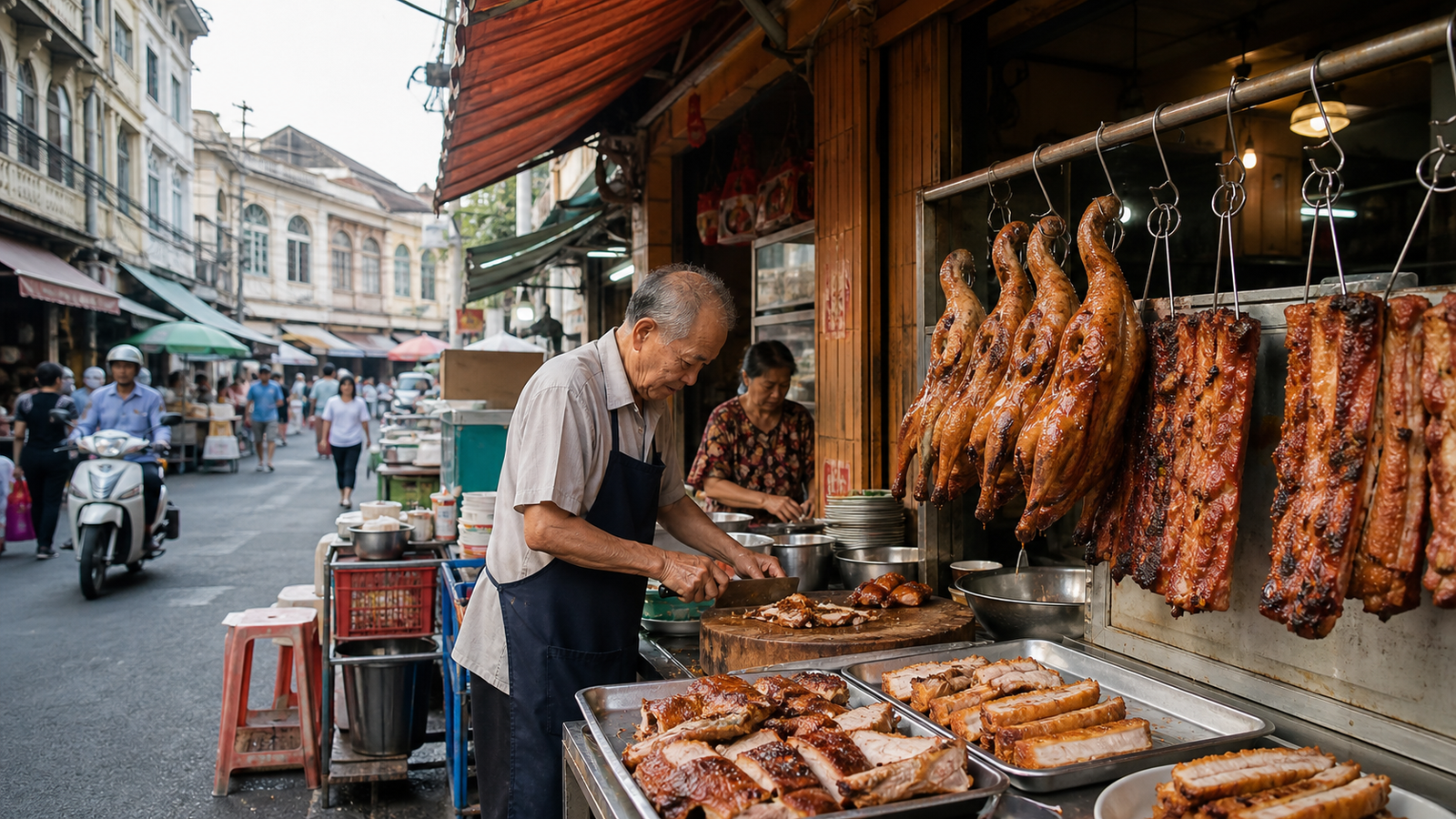
One of those is Jibi, a no frills old school eatery that’s been serving roast duck and grilled pork for decades. You know this place is good because it has a green plate sign behind the counter, meaning it’s been officially recognized for serving high quality, delicious food by Thailand’s own food authorities. The duck is roasted until the skin is perfectly crispy.
We then crossed the road for one of the most unique dishes I’ve eaten in all my time in Asia. Down a quiet alley was a humble street food stall run by a Vietnamese immigrant who started cooking here over 80 years ago. Since then, her signature dish has earned culinary awards in Bangkok and she’s even been invited to serve at major events. Y is like the name of this one.
Yun. So is mean snack or dessert.
Okay. And is mean like the crepe.
Yeah. Y is like a Thai word that Thai people call Vietnamese people.
So H is like the family that is from Vietnam.
Yeah. We have been running this shop right here for 80 years already.
The dish is a twist on the Vietnamese banh xeo, a crispy savory pancake filled with pork, vegetables, and fragrant spices. But here it’s been given a Thai style makeover that makes it unlike anything I’ve ever tasted. Oh, it’s got every flavor. Sweet, then it’s spicy, then it’s sour.
That last dish was like nothing I’d ever quite had before. I’d definitely never tried it. She said it was from Vietnamese origin, but interestingly, you can’t just turn up and eat at this street food stand. You have to order in advance. One of the reasons to do this tour is that they pre booked and pre ordered food that you can’t just turn up and order yourself. But wow, that was interesting. And that was definitely one of the nicest dishes I’ve ever had.
Thai Chinese Curries in a Historic Shophouse
At this point, our guide told us we were only halfway through the food and I was already full. But then we stepped into Nang Loeng Market and suddenly I had room again. This market has been around for over a century and is one of the oldest in Bangkok. It’s less chaotic than most markets, with a more local old school vibe. Many of the vendors here have been cooking the same dishes for generations.
Our next stop was a stall serving a rich, savory Chinese style eggplant dish, soft, sticky, and packed with umami. Right after that, we dove into an array of Thai curries, each with its own balance of spice and sweetness.
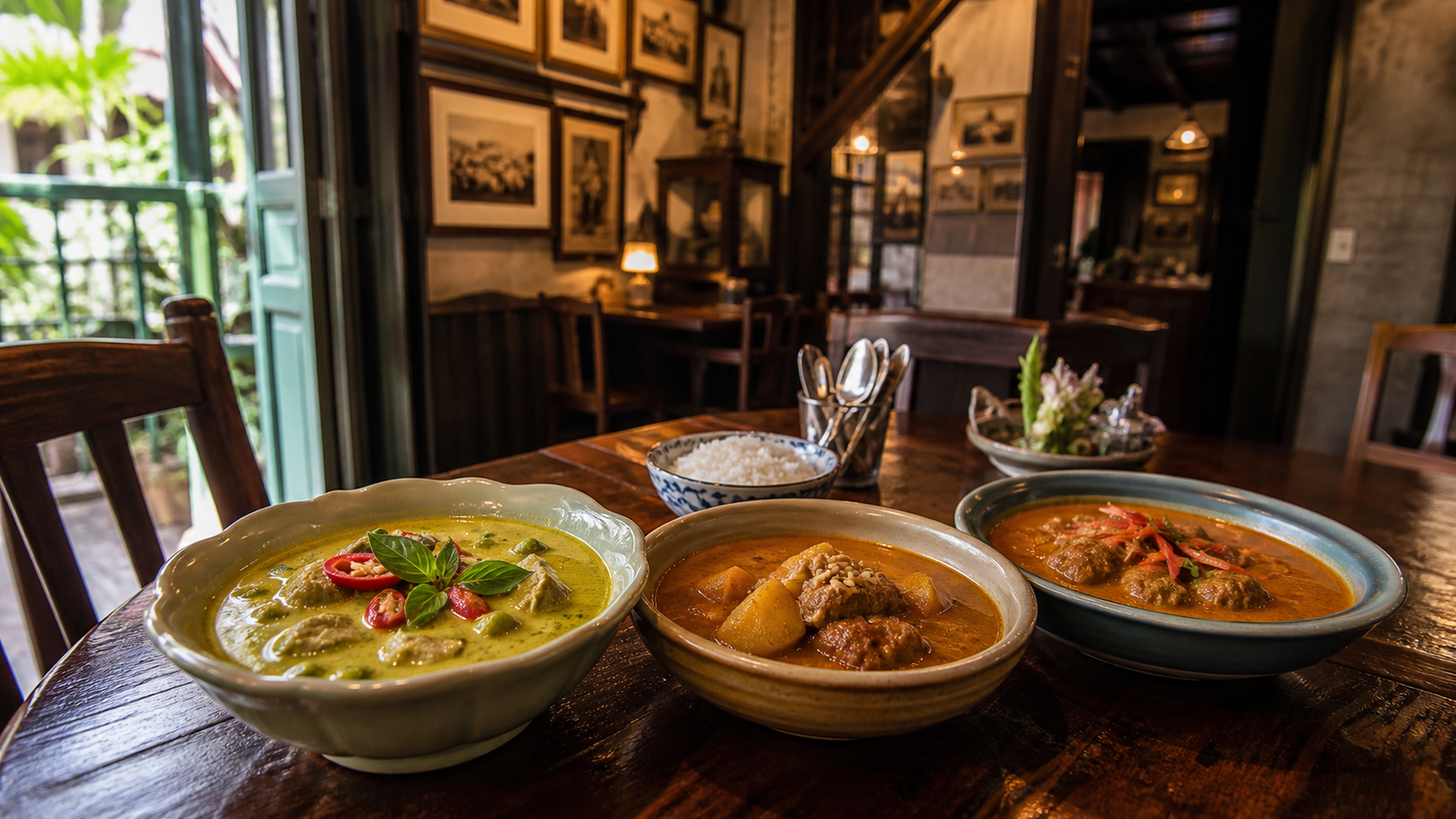
We stepped into an old Thai Chinese shophouse to sit down and eat. This place had a really cool traditional vibe, with old pictures of the Thai monarchy dotted around the restaurant. Here we tried three of the most popular Thai curries: green curry made with fresh green chilies, coconut milk, and Thai basil; Massaman curry, a rich slow cooked curry with Muslim roots, made with warm spices, cinnamon, and cardamom, as well as tender chicken and soft potatoes in a peanutty coconut sauce; and panang curry, packed with flavor from red chili paste and kaffir lime leaves.
I’m sometimes a little hesitant to eat Thai curries when I can see they’ve been sitting out for a while, but one of the benefits of doing a guided food tour is that you know for certain that the food is good. These were some of the best curries that I’ve ever had in Thailand.
Bangkok Desserts and the End of the Tour