First Hour in CHIANG MAI – Mistakes to Avoid
Immigration & Entry Requirements
If you’re arriving on an international flight, you’ll need to pass through immigration.
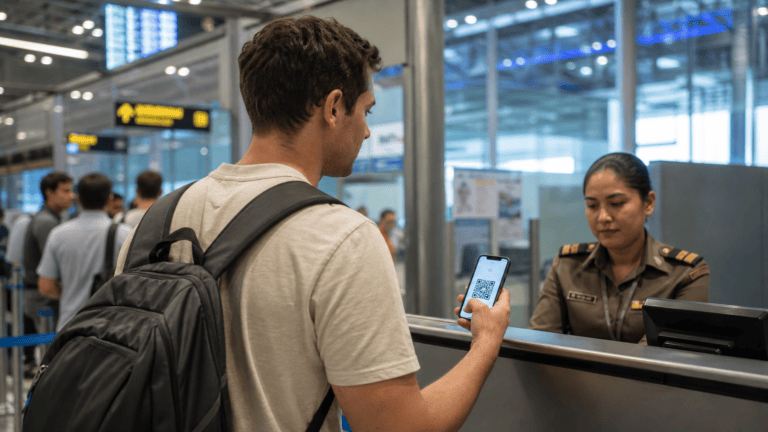
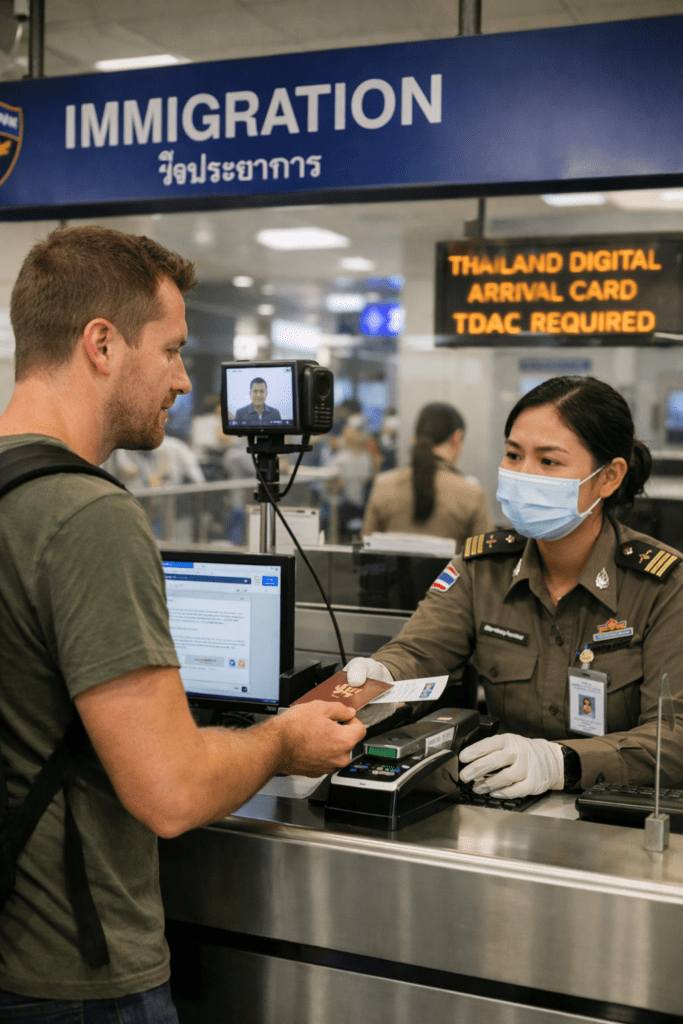
It’s important to remember that all foreign visitors must complete the Thailand Digital Arrival Card (TDAC) within 3 days before arrival.
At the immigration desk, you should hand over your passport and boarding pass, and you’ll need to take a photo and provide fingerprints.
You should also be prepared to show a hotel or accommodation booking for at least your first night and proof of onward travel in case the officer asks.
In rare cases, proof of funds may be requested, which is officially 20,000 baht per individual or 40,000 baht per family. But most travelers will simply be waved through without issue.
If you’re arriving on a domestic flight, you’ll skip immigration and walk straight into the arrival hall and baggage claim area and out to the terminal.
Money & ATMs
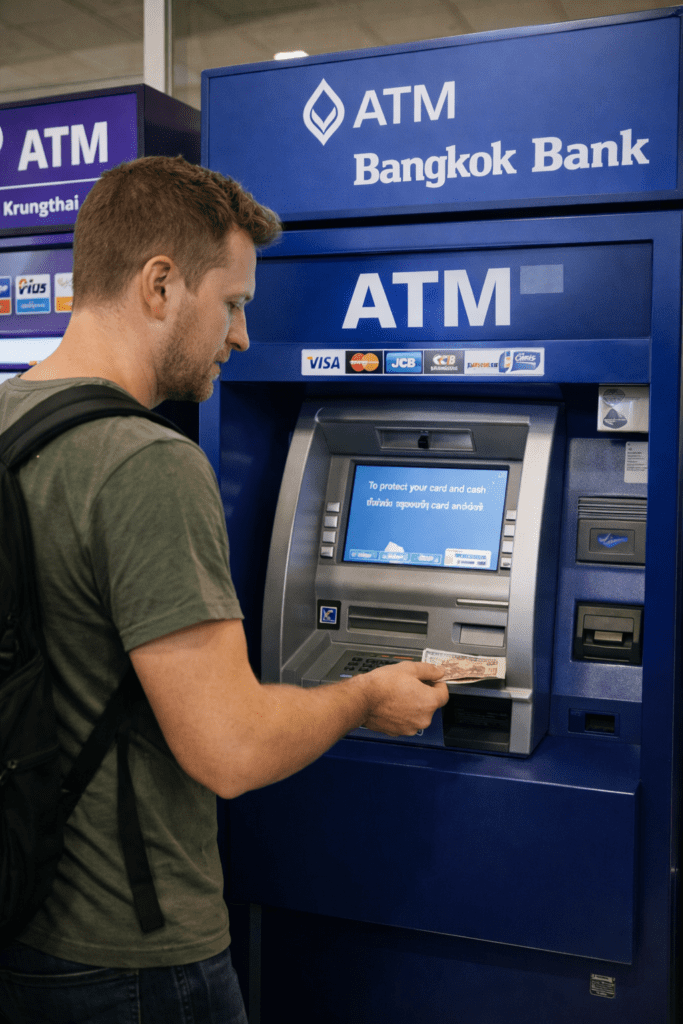
Next, we have money. And there really is no secret trick here at Chiang Mai International Airport.
First, you can withdraw cash from an ATM, which are easy to find and accept international cards, but they charge a fixed fee of 250 baht per withdrawal, plus any fees from your home bank.
To reduce fees, it’s better to withdraw a reasonable amount rather than making several small withdrawals. Or bring a travel debit card that reimburses foreign fees.
If the ATM asks whether you want to be charged in your home currency, always decline and choose to be charged in Thai baht.
Remember, Thai ATMs dispense cash first and card second. Many travelers forget their cards because of this reversed order, so always wait until the machine has fully finished before walking away.
Currency Exchange
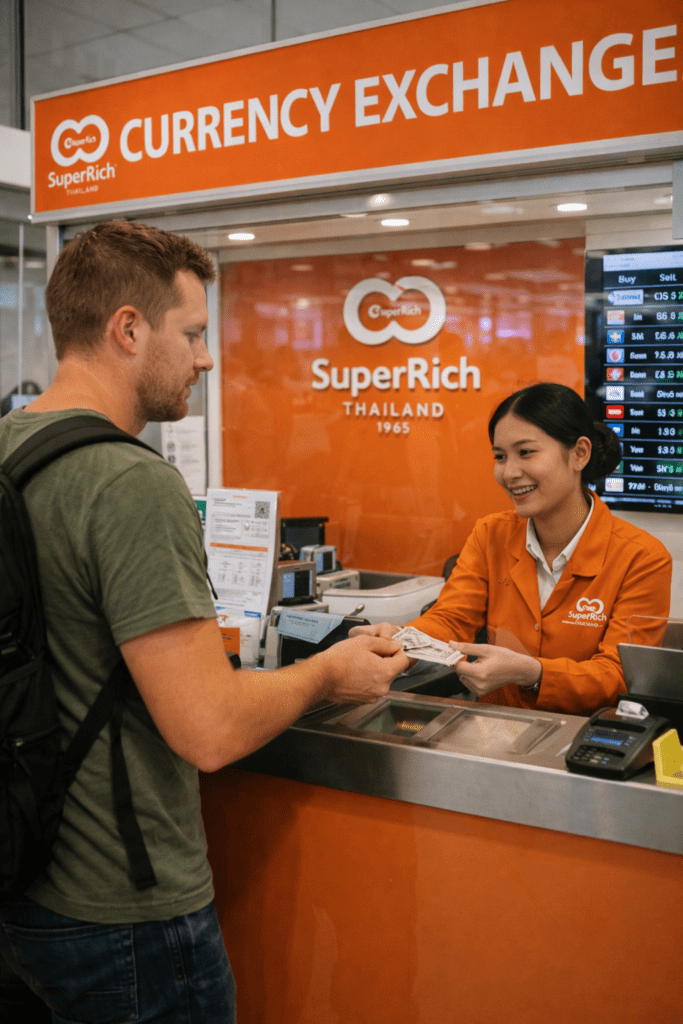
Your second option is exchanging cash at a currency exchange booth.
You’ll see plenty of bank booths, but the airport rates are not competitive. If you want the best rates, it’s better to exchange money in the city.
Reputable counters include Super Rich, SK Exchange, and Mr. Pierre.
If you’re arriving in Thailand through Bangkok first, exchange money there, where you’ll find the best rates at well-known chains including Super Rich, Happy Rich, Oh Rich, and Vasu.
SIM Cards & Mobile Data
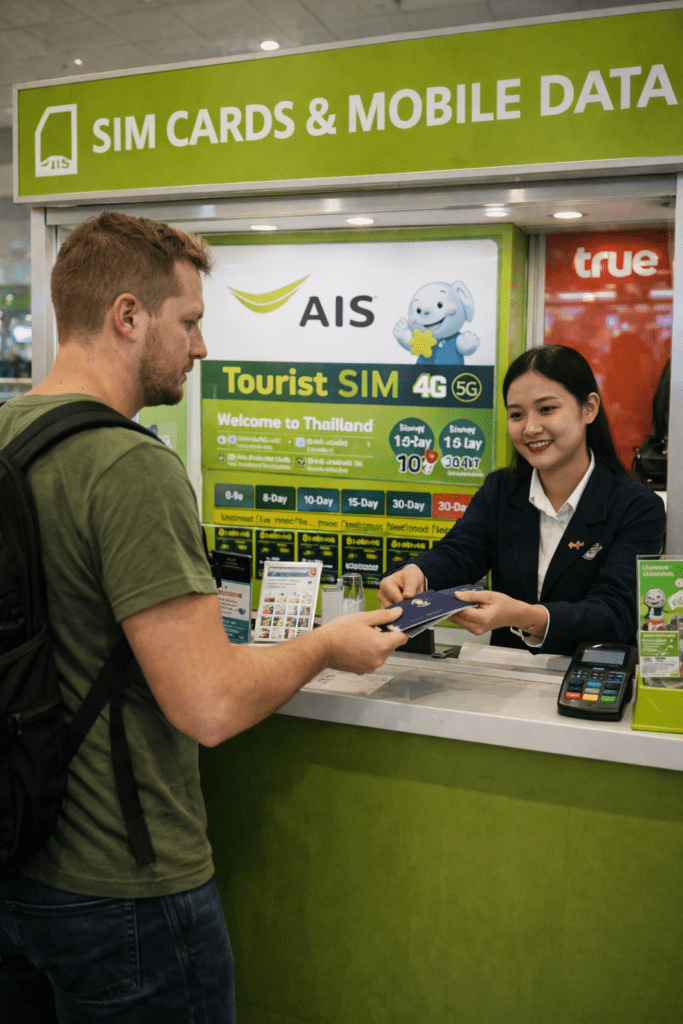
Next, we’ve got SIM cards. And this is one thing that many visitors overthink.
Choosing the best option for you just comes down to a trade-off between time and money.
To use mobile data in Thailand, you have three practical options: tourist SIMs, prepaid SIMs, or eSIMs.
The first option is a tourist SIM card, which you’ll see sold at the AIS and True Telecom counters in the arrivals hall. These are designed specifically for visitors and typically offer plans ranging from 8 to 30 days, and the plans are nearly identical.
You can also opt for a prepaid SIM, which is the cheapest option, but you’ll need to visit a service provider shop or 7-Eleven in the city to get it set up.
Finally, an eSIM allows you to activate mobile data digitally without swapping a physical SIM card.
eSIMs are particularly convenient for regional travelers as they let you avoid the hassle of swapping SIM cards in each new country, and high-quality eSIMs are now only marginally more expensive than a standard tourist SIM.
The best option ultimately comes down to your individual travel plans, budget, and personal preference.
Essential Apps
Before you fly, it’s also a good idea to download a few essential apps.
Grab and Bolt are the most commonly used ride-hailing apps.
Line is essential for text messaging.
Grab Food or Lineman handle food delivery.
The AQI app will allow you to monitor air pollution, and Rain Viewer is ideal for checking the weather, especially during the rainy season.
Transportation from the Airport
Finally, we’ve got transportation. And this one’s simpler than you might think.
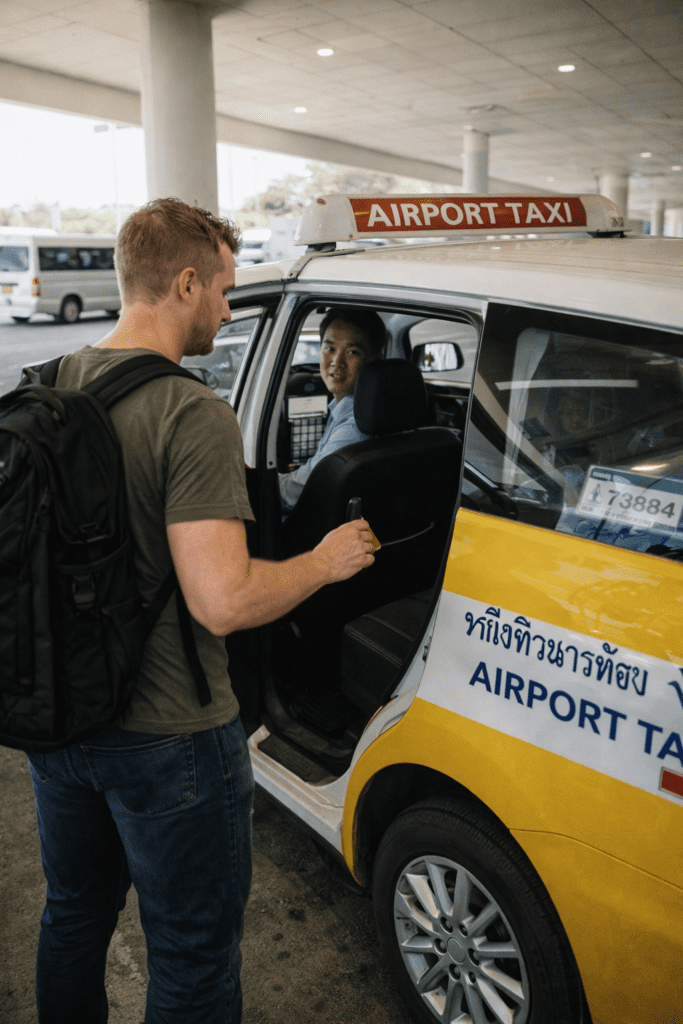
You have registered taxi booths inside the airport, ride-hailing services, public transportation, and car rentals.
The easiest choice for most travelers is the official airport taxi. These operate on a fare that should be confirmed at the official airport taxi counter for your destination before accepting the ride.
Simply walk up to the airport taxi counter, tell them where you’re going, and you’ll receive a ticket. Go outside at exit one, find your vehicle, and you pay the driver at the end of the ride.
Your second option is ride-hailing apps like Grab or Bolt. Simply order the ride and walk past the official taxis to the Grab pickup point.
Fares are flexible depending on distance, and this can be the ideal option if your accommodations are outside the city center.
Finally, you can take the city bus, which currently lists a 30-baht fare per trip; confirm the route and fare before boarding.
The stop is right next to the Grab pickup point with plenty of signs. Simply hop on board, wait for the conductor to approach you, pay the fare, receive the ticket, and he’ll ask where you’re going and let you know when to get off.
Food & First Stop Strategy
If you’re feeling hungry after landing, there are cafes and a few restaurants inside the airport.
But Chiang Mai is compact and the trip into the city is typically very fast.
In most cases, it’s better to head straight to your accommodation, drop your bags, and eat nearby rather than spending extra time at the airport.
You’ll have far more options once you’re in town. Prices are lower, and it’s a much more relaxed way to start your stay.
Baggage Storage
If you’re just stopping off in Chiang Mai, arriving early, or have time before check-in, it’s useful to know that baggage storage is available right at the airport.
There are staffed luggage storage facilities inside the terminal where you can leave bags for a few hours or longer.
Prices are reasonable and based on size and duration, making this a convenient option if you want to explore without carrying everything with you.
Airport Scams to Avoid
While you’re traversing the airport, you should be aware of two scams which can occur at airports throughout Thailand.
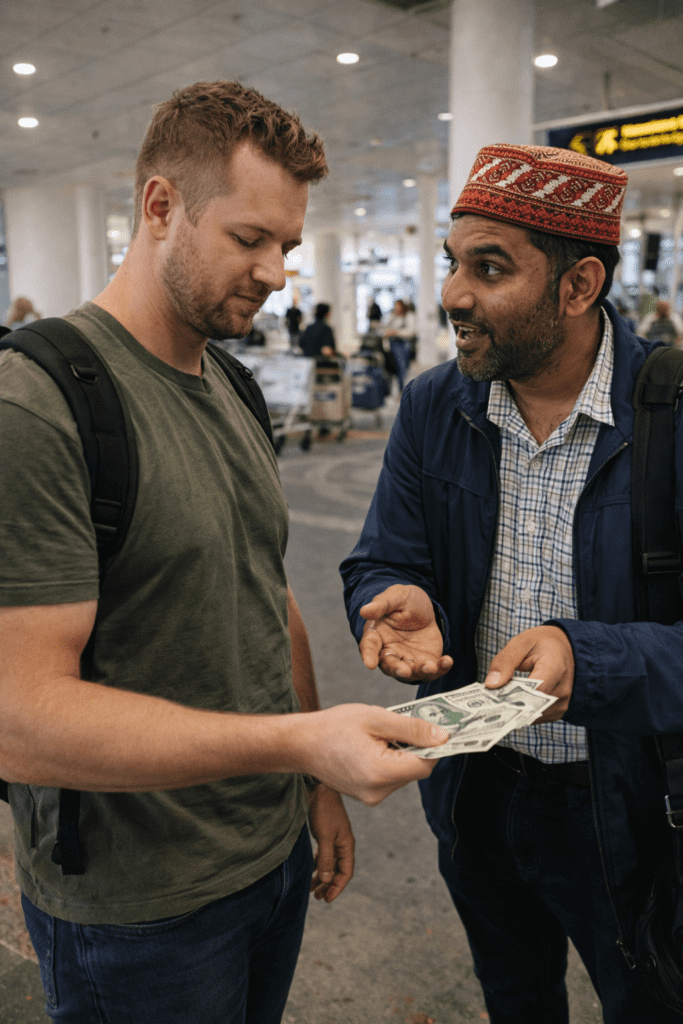
The first is the “show me your money” scam.
This usually involves a friendly stranger from South Asia or the Middle East striking up casual conversation and ultimately asking to see currency from your home country.
If you hand it over, they will attempt to distract you and use sleight of hand to pocket bills or trade it for counterfeit or worthless currency.
The safest response is simple: don’t show your money to anyone.
Be wary of overly friendly strangers that approach you and simply walk away.
The Destitute Traveler Scam
This typically involves someone claiming to be a foreign tourist who has lost their wallet or had their cards blocked and needs cash for food, accommodation, or a ticket.
The stories vary, but the goal is always the same to get money from sympathetic travelers.
As uncomfortable as it may feel, the best approach is to disengage and move on.
If you run into any problems or feel uncomfortable at any point, airport staff can help or you can contact the tourist police at 1155.