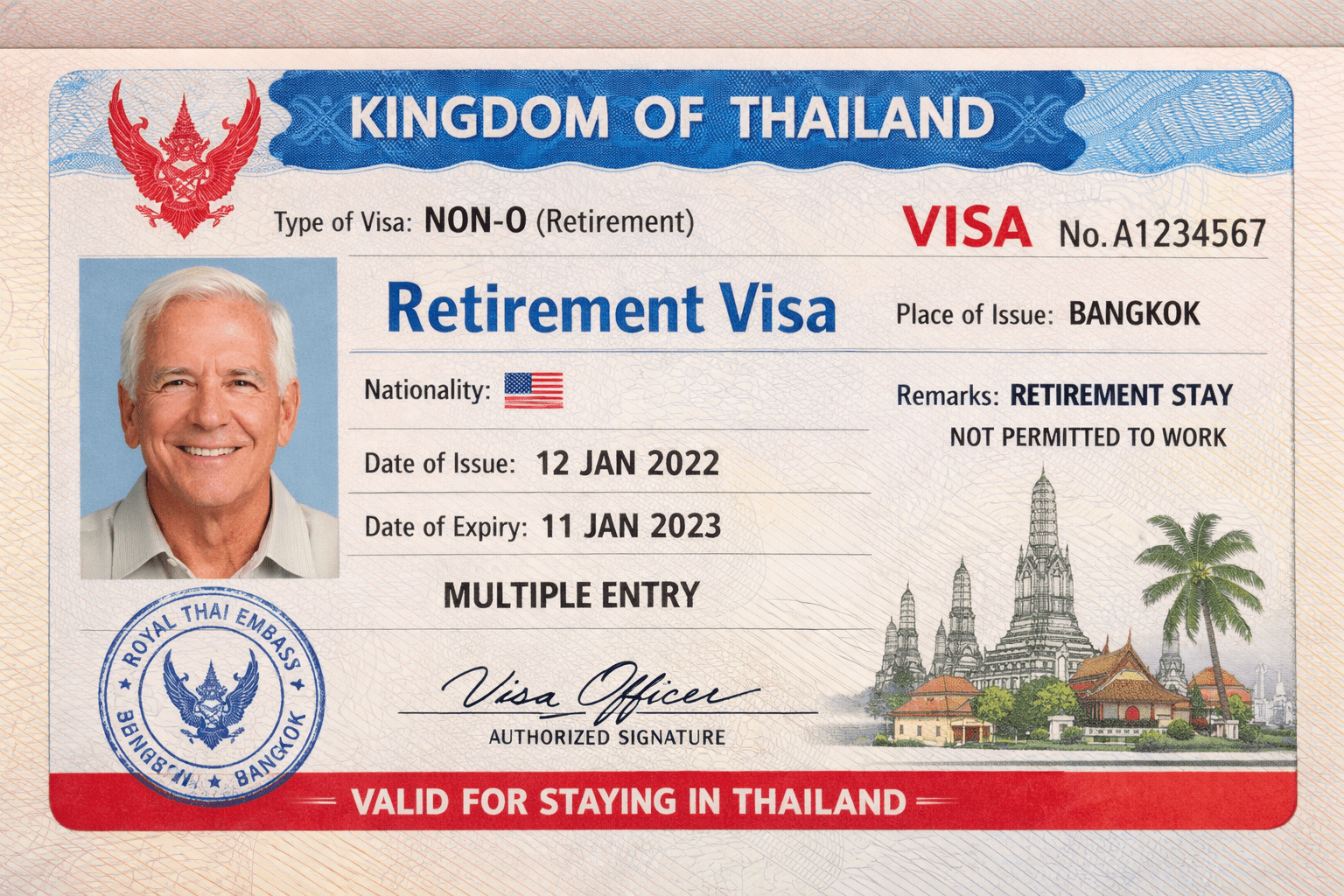
Retiring in Thailand: The Ultimate 2026 Visa Guide
Retiring in Thailand: The Ultimate 2026 Visa Guide (Everything You Need to Know)
Retiring in Thailand sounds simple. Beaches, warm weather, and a lower cost of living. But your retirement here will only work if you get the details right.
I’ll break down the full picture of retiring in Thailand step by step, we’ll cover the most important foundation, the visa paths that actually work, banking rules that trip people up, the immigration reporting systems that can turn into a headache if you ignore them, and how to navigate the entire process.
The Non-O Retirement Visa
If you want to stay in Thailand long term, you need a longstay visa. And the most widely used option is the non-o. The requirements are simple. You must be 50 years of age or older. And you must meet the financial requirements.
Proof of income or pension totaling at least 65,000 baht per month, proof of savings of at least 800,000 baht, or a combination of the two which totals 800,000 baht per year.
But while the requirements are simple, the application process can be confusing. So, let’s walk through it step by step.
Applying for the Non-O Visa
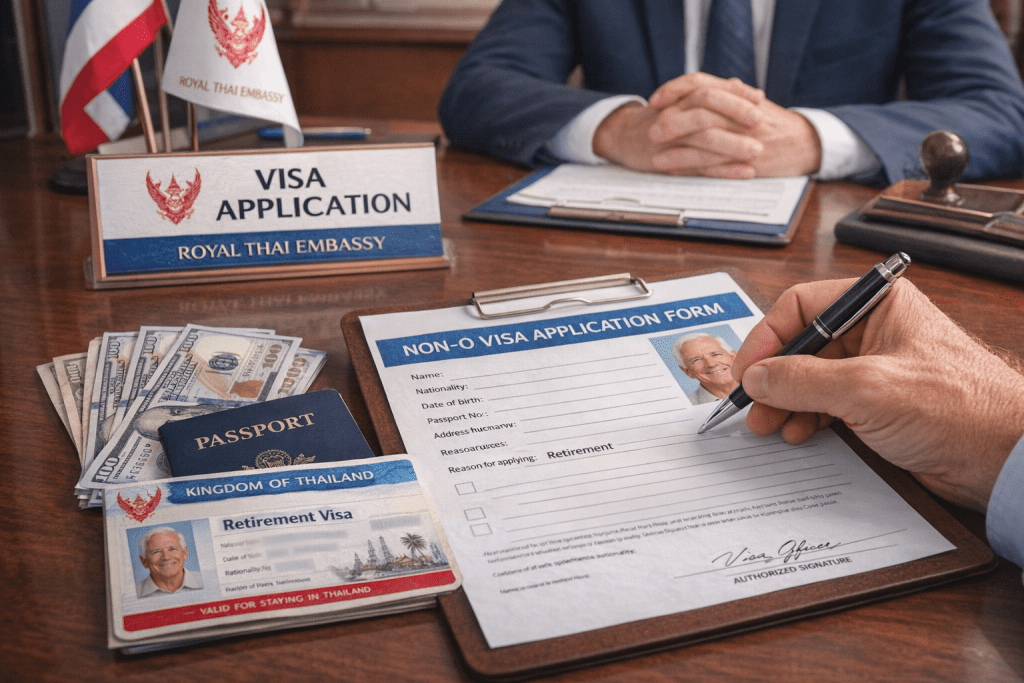
The first step is to apply at a Thai consulate or embassy in your home country. You’ll need to provide your passport, passport photos, proof of funds, which is normally a bank or income statement along with the complete application form and fee.
The fee is normally around 2,000 baht in your local currency, and different embassies and consulates can have additional requirements, so it’s always best to check the specific website before you apply.
Approval gives you a single entry non-o visa which is valid for 90 days. You’ll need to complete the full application once you’re inside Thailand in order to extend it for the full year.
When you arrive at the immigration desk at the airport, make sure to present the non-o visa to ensure that you’re stamped in correctly. Once you’re in, the clock starts and you have three months to apply at immigration for a one-year extension of stay based on retirement.
The One-Year Extension of Stay
The extension of stay is what actually allows you to live in Thailand for the full year, and it has a separate application and approval process.
It’s nearly identical to the initial non-o entry visa application, but the proof of funds is far more complicated.
If you opt for proof of income, immigration will want hard proof. This sounds simple in theory, but in practice, it’s frustrating. Years ago, you could swear an affidavit at your embassy and immigration would accept it.
But since 2019, the United States, United Kingdom, and Australian embassies stopped issuing those letters.
So, immigration now wants proof they can verify directly. That means regular transfers into a Thai bank account, passbook entries showing those deposits, and sometimes pension or social security statements if things don’t line up neatly.
And there are headaches. If your pension pays quarterly or annually, immigration may reject it because they want monthly deposits. And offices don’t always interpret evidence the same way.
Bangkok might accept overseas pension letters with translations while Chiang Mai insists on passbook deposits.
The 800,000 Baht Method and Thai Bank Accounts
Because of all this, many retirees skip the income route and instead use the lump-sum method, parking 800,000 baht in a Thai account. But here’s the catch 22. To prove the deposit, you need a Thai bank account first.
And most banks won’t open one if you’re only on a tourist visa. That’s why arriving on a non-o is so important. And with it in your passport, you’ll be able to open a Thai bank account.
But even with the correct resident visa, opening a bank account can be a challenge. Bring your passport and ideally a lease agreement. If you don’t have a lease yet, ask your hotel for a letter confirming your stay and bring your booking confirmation as backup.
Sometimes a staff member will open the account on the spot with just your passport and non-o visa. Other times you’ll be asked for more documents like a resident certificate and occasionally you’ll just be told it isn’t possible.
The truth is that different branches follow different rules and some staff simply don’t know how to open accounts for foreigners. Rather than admit that, they’ll often say it can’t be done, but it can. If one branch turns you away, just try another.
In tourist and expat areas, you’ll have better luck, but results vary. The most foreigner friendly banks tend to be Bangkok Bank, Kasikorn, Krung Thai, and SCB.
And if you absolutely need a resident certificate, you can request one from a local immigration office. And much like the banks, requirements at immigration can also vary.
You may be asked for your lease, a hotel letter, or even a TM30, which we’ll discuss later. It’s all very inconsistent, and this is a common complaint among retirees.

Transferring and Seasoning the 800,000 Baht
Once the account is open, you need to transfer in the 800,000 baht, and you need to do it the right way. Immigration doesn’t just want to see a balance. They want to see that the money came from abroad in your name.
That proof comes from the FETF, which the bank staff may know better as the tour 3. Without that slip, your deposit won’t count.
The safest method is a swift transfer directly from your home bank, but fintech services like Wise or Revolute can also work if the Thai bank can generate the paperwork. Always send in your home currency, never in baht, so the bank records the conversion and issues the FETF.
The smart move is to test first. Send a small amount, ask for the FETF, and confirm the bank can produce it. If they can, you’re good to go. If not, change method before moving the full amount.
And timing matters. Immigration won’t count your deposit unless you meet the seasoning period rules. The money must sit in your account for 2 months before you apply. Remain untouched for 3 months after approval and then never fall below 400,000 for the rest of the year.
As you’re entering on a 90-day non-o visa, you’ll want to open the account and transfer the funds as quickly as possible to ensure that you meet the seasoning requirement.
And the following year, you’ll repeat the process. 800,000 baht in the account 2 months before and 3 months after your visa renewal and 400,000 throughout the rest of the year.

Other Visa Options
So that’s how the non-o visa works. But what about the other visas that you might hear about? The OA, the OX, the LTR, DTB, or even the privilege elite. Each one comes with different requirements, costs, and limitations. Let’s go through them one by one so that you can see which if any meets your needs.
The OA Visa
The OA visa is often called the retirement visa from abroad. It looks similar to the O but with a key advantage. When you apply at your local Thai consulate, you can show the financial requirement using your home bank or pension documents.
But the OA comes with heavier baggage. OA requires police clearance, a medical certificate, and Thai compliant insurance. And when it comes time to renew after the first year, you must meet the same financial rules as the O visa.
That means the 800,000 must be in a Thai bank account, seasoned 2 months before and 3 months after renewal, and never below 400,000 for the rest of the year.
So, while the OA saves you the banking hassle upfront, it doesn’t let you avoid it forever.
The OX Visa
The OX visa promises up to 10 years, five years renewable once, but it’s niche. You must be from one of 14 eligible countries, be over 50, and transfer 3 million baht into a Thai bank account, and at least 1.5 million must remain untouched at all times.
You’ll also need a police clearance, a medical certificate, and Thai compliant insurance.
The LTR Visa
The LTR visa is Thailand’s flagship. If you qualify, you get a 5-year visa, renewable once for 10 years total, lighter reporting requirements, family coverage, and even work authorization.
For retirees, it’s called the wealthy pensioner category. And to qualify, you’ll need a passive income of at least $80,000 per year or $40,000 plus a quarter million investment in Thailand. You also need health insurance or financial guarantees.
The DTV Visa
The DTV visa is the newest visa option. It’s not technically a retirement visa, but it can be used as a longstay option for anybody, including retirees. It’s valid for five years and costs 10,000 baht.
To qualify, you must be over 20 and show at least half a million baht in savings held in your home bank account for at least 3 months before application. You apply online through the e visa system or at a Thai consulate.
And once approved, you’ll be granted a 5-year visa, which allows you to stay for up to 180 days per entry. After the 180 days, you can leave and re-enter freely to reset the clock, or you can extend it once for an additional 180 days at a cost of 1,900 baht.
But with recent crackdowns on Visa and banking abuse, Thai banks normally don’t accept the DTV as a basis to open an account as it’s technically a tourist visa.

Thailand Privilege Visa
Finally, there’s the Thailand privilege visa, formerly called Elite. This is less a visa than a membership program bundled with residency. Packages start at 650,000 baht for five years and go up to 2.5 million for 15.
You skip financial proof. You skip insurance and you skip annual renewals. You get fast-track at airports, concierge help with 90-day reports and support opening bank accounts or getting a license. If convenience is worth the cost, it’s the smoothest option of all.
Immigration Reporting and Ongoing Requirements
And once you’re in the system, you’ll need to understand the reporting rules. Every 90 days, you confirm your address with immigration in perpetuity. And you can do it in person at an immigration office, by mail, or online so long as the website is functioning. If you miss the deadline, you’ll need to pay a fine.
Travel is another piece. In order to keep the visa when you travel abroad, you’ll need something called a re-entry permit. A single re-entry costs 1,000 baht. If you travel abroad more often, you can get a multiple re-entry visa, which allows for unlimited travel in and out of Thailand and costs 3,800 baht.
When leaving the country, you’ll need to go to the re-entry desk at the airport prior to passing through immigration, and they will put a re-entry stamp in your passport, or you can stop off at an immigration office before you travel.
The TM30
Then there’s the TM30. Technically, it’s your landlord’s responsibility. Within 24 hours of you moving in, they must file the report with immigration, and they will need to provide you with the receipt.
But the punishment for non-compliance falls on the foreign tenant and lacking a TM30 can lead to visa problems. Always ensure that TM30 reporting is clearly outlined in the lease. And when you first move to Thailand, it’s ideal to work with larger real estate agencies, which will handle the whole process.
Digital Arrival Card
And finally, since May 1st, 2025, you’ll need to fill in a digital arrival card called the TDAC within 72 hours before arriving in Thailand. And you’ll need to do it every time you enter the country.
Visas and money aren’t just the first step to retiring in Thailand. They’re the foundation. If you get them right, everything else is a lot easier. And in the next episode, we’ll cover health care and health insurance because protecting your health is just as important as protecting your money.